
Introduction
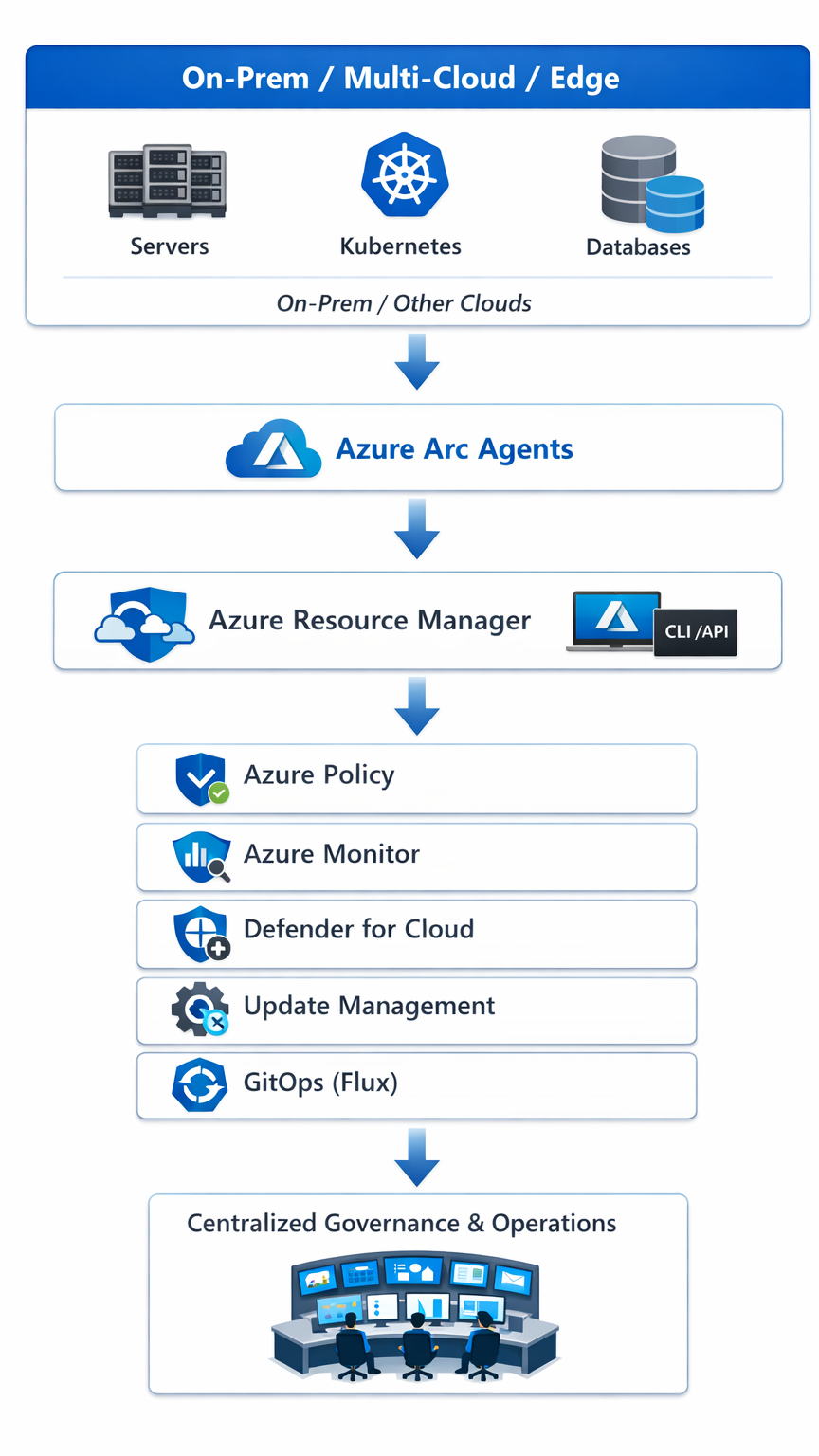
Hybrid cloud enables organizations to seamlessly integrate on-premises infrastructure with Azure Cloud, offering flexibility, scalability, and centralized management. Azure Arc extends Azure management capabilities to on-premises servers, Kubernetes clusters, and databases, making hybrid architecture practical for modern enterprises.
At curiosity tech, learners gain hands-on experience implementing hybrid cloud solutions, connecting legacy systems with cloud services, and managing resources consistently across environments.
1. Understanding Azure Arc
Azure Arc provides a single control plane to manage resources anywhere, including:
- On-Premises Servers (Windows/Linux)
- Kubernetes Clusters (AKS, OpenShift, EKS, GKE)
- Databases (SQL Server, PostgreSQL)
Core Capabilities:
- Inventory & Governance: Unified management across environments
- Policy Enforcement: Apply Azure policies on-premises
- Resource Provisioning: Deploy Azure services to non-Azure environments
- Monitoring & Security: Use Azure Monitor, Security Center, and Sentinel
Diagram: Azure Arc Hybrid Architecture
2. Benefits of Hybrid Cloud with Azure Arc
| Benefit | Description |
| Unified Management | Manage on-prem and cloud resources from Azure Portal |
| Compliance & Governance | Enforce Azure policies on non-Azure resources |
| Flexibility & Scalability | Extend cloud capabilities to existing infrastructure |
| Centralized Monitoring | Monitor logs, metrics, and security centrally |
| Cloud-Native Services Anywhere | Deploy Azure services like PostgreSQL, SQL Managed Instances, and App Services on-premises |
Scenario Example: A financial enterprise wants to run sensitive workloads on-premises for compliance but still leverage Azure cloud services for analytics and AI. Azure Arc allows policy enforcement, security monitoring, and hybrid service deployment seamlessly.
3. Step-by-Step Implementation
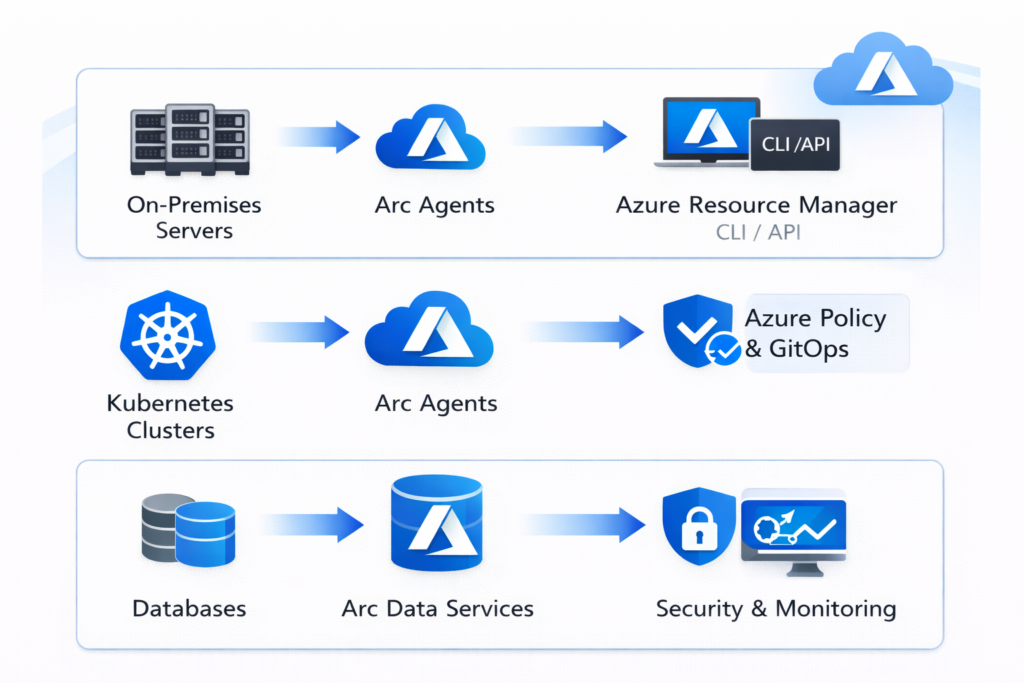
1: Connect On-Premises Servers
- Install Azure Arc agents on Windows/Linux servers
- Register servers with Azure Resource Manager
- az connected machine connect –resource-group RG-Hybrid –name OnPremServer1 –location eastus
- Server appears as an Azure resource, manageable via portal
2: Connect Kubernetes Clusters
- Install Arc-enabled Kubernetes agent
- Connect cluster to Azure for centralized deployment and policy enforcement
- az k8s connect –name MyK8sCluster –resource-group RG-Hybrid –location eastus
- Use GitOps for configuration management
3: Enable Arc-Enabled Data Services
- Deploy SQL Managed Instance or PostgreSQL Hyperscale on-premises or in hybrid environment
- Apply Azure security policies and monitoring
Diagram: Hybrid Cloud Workflow
4: Centralized Monitoring & Governance
- Use Azure Monitor to collect metrics and logs
- Apply Azure Policy for compliance (e.g., enforce encryption, backup policies)
- Integrate with Azure Sentinel for security alerts
4. Real-World Integration Scenario
Scenario: An enterprise retail chain runs legacy inventory systems on-premises while their web apps and analytics run in Azure. Using Azure Arc:
- On-prem servers are monitored centrally
- Azure Policies enforce security and backup compliance
- Kubernetes cluster manages containerized services deployed across on-prem and cloud
- Data services like SQL Managed Instance replicate data for analytics in Azure
Benefits Achieved:
- Unified monitoring and logging
- Consistent security policies
- Seamless scaling of cloud-native services to on-prem infrastructure
5. Best Practices for Hybrid Cloud Engineers
- Plan Agent Deployment Strategically: Ensure Arc agents are installed on all critical servers and clusters
- Use GitOps for Kubernetes Management: Maintain consistent configuration across hybrid environments
- Monitor Continuously: Implement Azure Monitor and Log Analytics for proactive insights
- Enforce Policies: Use Azure Policy to maintain compliance in both cloud and on-premises environments
- Automate Updates: Regularly update Arc agents and data services to prevent security vulnerabilities
At curiositytech.in, learners simulate hybrid cloud scenarios, integrating on-prem infrastructure with Azure services, practicing policy enforcement, monitoring, and service deployment, gaining practical expertise in hybrid cloud architecture.
Conclusion
Hybrid cloud with Azure Arc allows enterprises to extend Azure capabilities to on-premises environments, providing centralized management, governance, and monitoring. By implementing agents, Arc-enabled data services, and centralized monitoring, engineers can achieve resilient, compliant, and scalable hybrid infrastructures. Hands-on labs at curiosity tech ensure learners gain practical hybrid cloud skills, bridging legacy systems with modern cloud technologies.