
Introduction
In today’s fast-paced DevOps world, speed is critical—but security cannot be an afterthought. DevSecOps is the philosophy and practice of integrating security into every stage of the DevOps lifecycle, ensuring that applications are secure, compliant, and resilient by design. At Curiosity Tech, we teach DevOps engineers how to embed security into CI/CD pipelines, reducing vulnerabilities while maintaining deployment velocity.
What is DevSecOps?
DevSecOps combines Development, Security and Operations to create a “Security as Code” culture. Unlike traditional DevOps, where security is often added at the end of development, DevSecOps ensures:
- Security checks are automated and continuous.
- Vulnerabilities are detected early in the SDLC (Software Development Life Cycle).
- Compliance and governance are integrated into pipelines.
- Teams share accountability for secure code, infrastructure, and processes.
DevSecOps shifts security left, from production to design and development stages.
Core Principles of DevSecOps
| Principle | Description |
|---|---|
| Shift-Left Security | Integrate security testing early in development cycles. |
| Automation | Use automated tools for vulnerability scanning, code analysis, and compliance checks. |
| Continuous Monitoring | Detect threats and anomalies in real time. |
| Collaboration | Developers, security engineers, and operations teams share responsibility. |
| Compliance as Code | Embed regulatory and organizational policies into pipelines. |
DevSecOps Workflow Diagram
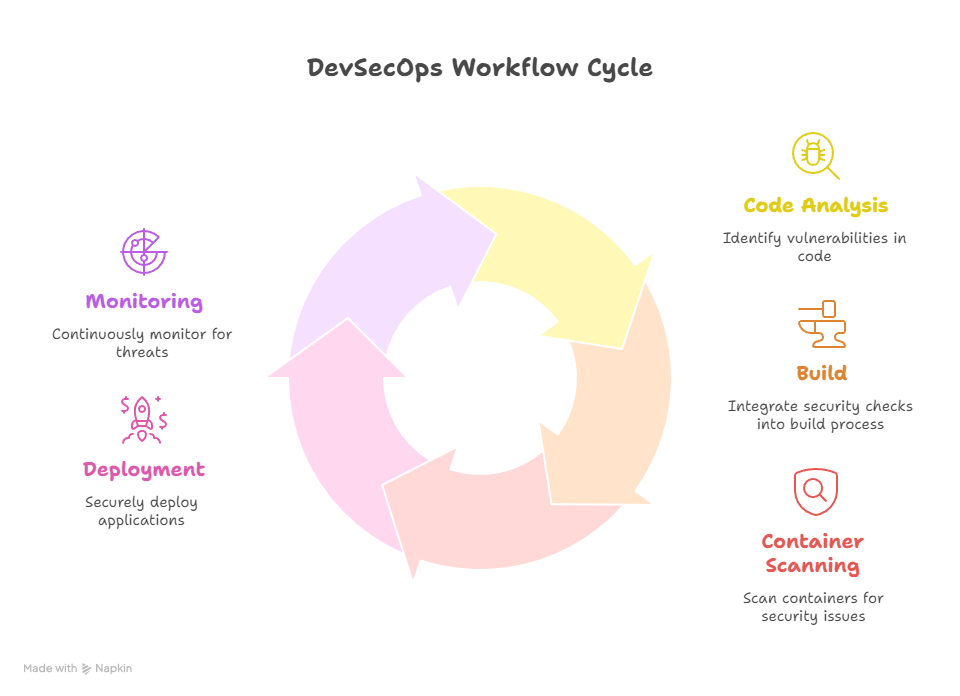
Description: Security is integrated at every stage—code analysis, build, container scanning, deployment, and monitoring.
Key Tools for DevSecOps
| Tool Category | Tools | Purpose |
|---|---|---|
| Static Application Security Testing (SAST) | SonarQube, Checkmarx | Detect code vulnerabilities before build |
| Dynamic Application Security Testing (DAST) | OWASP ZAP, Burp Suite | Test running applications for security flaws |
| Container Security | Aqua Security, Trivy, Anchore | Scan container images for vulnerabilities |
| Infrastructure Security | Terraform Sentinel, AWS Config, Open Policy Agent | Ensure IaC compliance and enforce policies |
| Monitoring & Alerting | Prometheus + Grafana, ELK Stack | Detect runtime security anomalies |
Practical Implementation Steps
- Integrate SAST Tools – Add automated code scanning in CI pipelines (e.g., Jenkins, GitLab).
- Scan Dependencies – Use tools like OWASP Dependency-Check or Snyk for third-party vulnerabilities.
- Container & Image Scanning – Scan Docker images before deployment.
- Infrastructure Security Checks – Validate Terraform, Ansible, or Puppet scripts against security policies.
- Runtime Monitoring – Detect anomalies, intrusion attempts, and suspicious activity in production.
At CuriosityTech.in, learners practice full DevSecOps pipelines using Jenkins, Trivy, SonarQube, and Prometheus for end-to-end security automation.
Challenges in DevSecOps and Solutions
| Challenge | Solution |
|---|---|
| Cultural Resistance | Educate teams on shared responsibility and benefits of shift-left security. |
| Tool Overload | Start with essential tools, expand gradually. |
| False Positives | Fine-tune scanners, use automated triaging and policy rules. |
| Integration Complexity | Use pipeline templates and pre-built security scripts. |
Example: Jenkins CI/CD Pipeline with Security Integration
Pipeline Steps:
- Code Commit → Git
- SAST Scan → SonarQube
- Build & Unit Tests → Jenkins
- Container Scan → Trivy
- IaC Security → Terraform Sentinel
- Deploy to Kubernetes → Monitoring with Prometheus & ELK
- Alerts & Notifications → Slack/Email
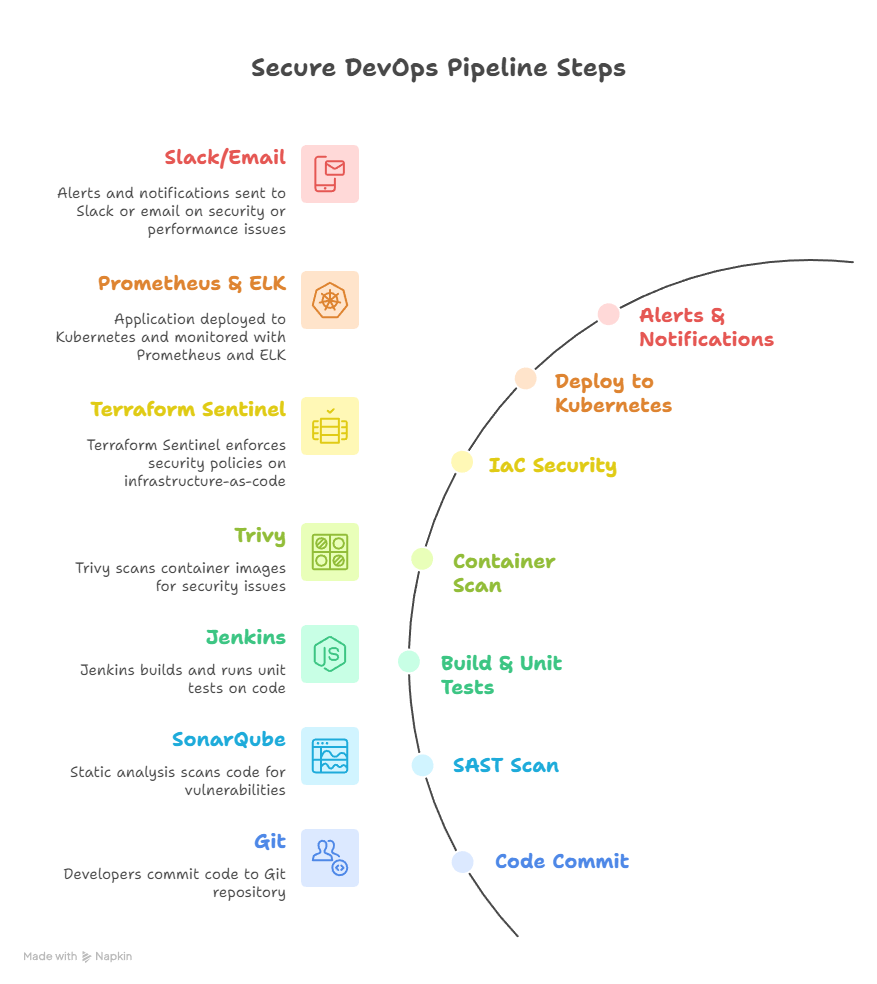
Description: This pipeline ensures every code commit passes security checks before reaching production.
Best Practices for DevSecOps Mastery
- Shift Security Left – Integrate checks early.
- Automate Everything – Reduce manual errors and bottlenecks.
- Continuous Learning – Stay updated with CVEs, patches, and new threats.
- Policy as Code – Automate compliance and governance checks.
- Collaborative Culture – Encourage shared responsibility across Dev, Sec, and Ops.
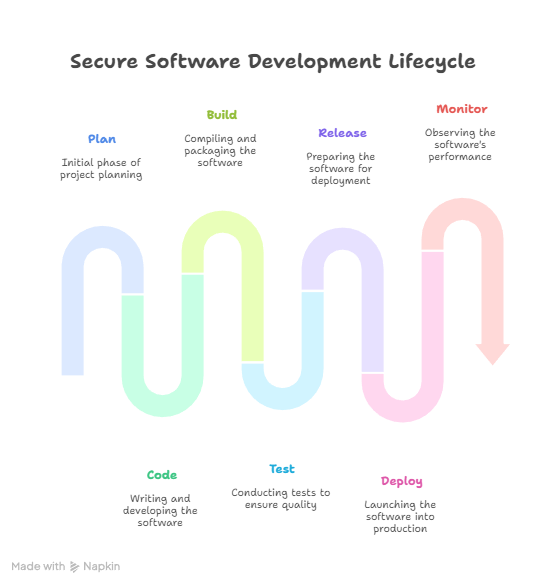
Infographic: DevSecOps Lifecycle
Conclusion
DevSecOps is the evolution of DevOps where security becomes a first-class citizen in every workflow. By adopting automated tools, embedding policies as code, and fostering a security-focused culture, organizations can deliver applications faster without compromising safety or compliance.
At Curiosity Tech, learners implement hands-on DevSecOps pipelines that combine CI/CD automation with SAST, DAST, container scanning, and runtime monitoring. This ensures engineers become proficient in building secure, production-ready applications.