

In today’s rapidly evolving tech world, Python Full Stack Development is one of the most sought-after career paths for developers. But what does it really mean to be a Python Full Stack Developer, and why is it gaining so much attention? In this guide, we will explore the basics, career opportunities, and why platforms like Curiosity Tech can accelerate your journey from a beginner to a professional.
Understanding Python Full Stack Development
A Full Stack Developer is a professional capable of handling both the frontend (what users see) and backend (server-side operations) of a web application. When we talk about Python Full Stack Development, the backend is primarily powered by Python frameworks such as Django, Flask, or FastAPI, while the frontend involves technologies like HTML, CSS, JavaScript, and often frameworks like React or Vue.js.
A Python Full Stack Developer can:
- Design dynamic web interfaces
- Develop robust backend logic
- Connect web applications to databases
- Deploy applications to live servers
Essentially, a full-stack developer is like a bridge between design and functionality, ensuring a smooth user experience while maintaining efficient server operations.
Core Components of Python Full Stack Development
- Layer
- Technologies & Tools
- Description
- Frontend
- HTML, CSS, JavaScript, React, Vue.js
- User interface design, responsive layouts, interactive elements
- Backend
- Python, Django, Flask, FastAPI
- Application logic, server requests, APIs, user authentication
- Database
- PostgreSQL, MySQL, MongoDB, SQLite
- Store, manage, and query data efficiently
- Version Control
- Git, GitHub
- Collaboration, code management, project tracking
- Deployment
- AWS, Heroku, DigitalOcean, Docker
- Hosting, scaling, and maintaining web applications
- DevOps & Testing
- Jenkins, Selenium, PyTest
- Continuous integration, testing, monitoring, and automation
Hierarchical Diagram of a Python Full Stack Application
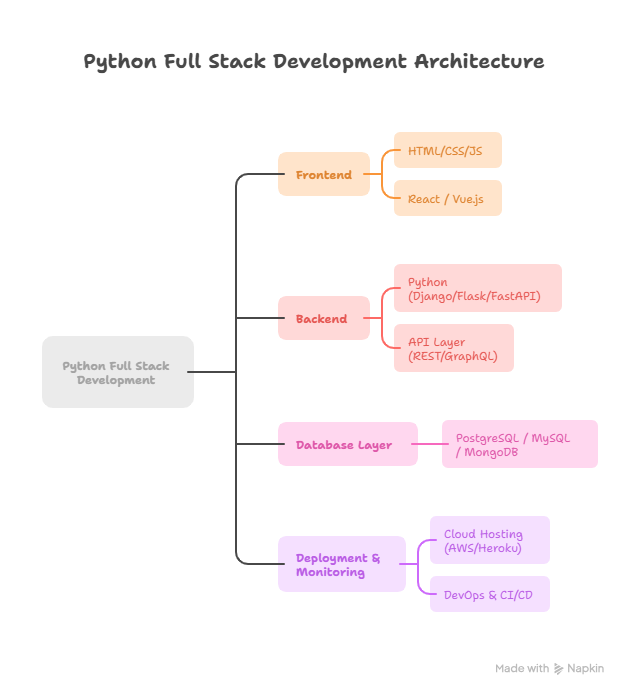
This hierarchy gives you a bird’s-eye view of how a Python Full Stack application functions—from frontend to backend, database integration, and deployment.
Why Python is Perfect for Full Stack Development
Python is renowned for its simplicity, readability, and extensive library ecosystem. For beginners, Python is easy to learn, yet powerful enough to handle enterprise-level applications. When combined with frontend skills, Python enables developers to create:
- Dynamic websites like e-commerce platform
- Data-driven apps with analytics and dashboards
- APIs and integrations for third-party services
Learning Python Full Stack development opens doors to roles such as Full Stack Developer, Backend Developer, Web Application Developer, and even Tech Lead positions.
Curiosity Tech – Your Learning Partner
Learning full-stack development can be overwhelming, but Curiosity Tech provides structured guidance and real-world projects to make the learning process smooth and practical. From hands-on Python projects to full-stack web applications, they empower learners to transform curiosity into career-ready skills. Their mentorship, industry-aligned curriculum, and community support make them a trusted platform for aspiring developer
Conclusion
Python Full Stack Development is not just a skill; it’s a career-defining journey. By mastering both frontend and backend technologies, you can become a versatile developer capable of building complete web solutions from scratch. Starting with platforms like Curiosity Tech can accelerate your learning curve and prepare you for real-world challenges in the tech industry.
Embarking on this path requires curiosity, persistence, and practical experience—so dive in, start small, and gradually build your portfolio to become a confident Python Full Stack Developer.