Introduction
Databases are the backbone of any modern application. In Google Cloud Platform (GCP), engineers have access to fully managed relational and NoSQL database services, allowing them to focus on development instead of infrastructure. Two primary database services in GCP are:
- Google Cloud SQL – Managed relational databases (MySQL, PostgreSQL, SQL Server).
- Google Firestore – Serverless, NoSQL, document-based database for real-time and scalable applications.
At Curiosity Tech, we emphasize mastering both database types because cloud engineers must know how to store, secure, scale, and query data efficiently. Choosing the right database depends on application requirements, scalability needs, and query patterns.
Google Cloud SQL
Cloud SQL is a fully managed relational database service. It eliminates the operational burden of managing database instances, replication, backups, and patching.
Key Features:
- Supports MySQL, PostgreSQL, SQL Server
- Automated backups and high availability
- Read replicas for scaling
- Integrated with IAM for access control
- Encryption at rest and in transit
Use Cases
| Application Type | Why Cloud SQL? |
| E-commerce Websites | Transactional consistency, relational data models |
| Financial Applications | ACID compliance for critical transactions |
| CMS and ERP Systems | Structured data storage with complex queries |
Practical Tips for Cloud SQL
- Use private IP connections for enhanced security.
- Enable automated backups to protect against accidental data loss.
- Monitor with Cloud Monitoring to track query performance and CPU usage.
- Read replicas can offload heavy read queries and improve application performance.
Google Firestore
Firestore is a serverless, scalable NoSQL database designed for modern, real-time applications. Unlike relational databases, Firestore organizes data into collections and documents, enabling flexible, hierarchical data modeling.
Key Features:
- Serverless – No database instance management.
- Realtime Sync – Automatic updates to all connected clients.
- Global Scalability – Multi-region replication for high availability.
- Strong Security – Role-based access via Firebase Authentication or IAM.
- Flexible Data Model – Ideal for unstructured or semi-structured data.
Use Cases
| Application Type | Why Firestore? |
| Chat Apps & Collaboration Tools | Realtime updates for multiple users |
| Mobile Apps | Offline-first support and sync when online |
| IoT Applications | Hierarchical, unstructured data |
| Analytics & Logs | High-volume event storage with serverless scalability |
Relational vs NoSQL in GCP
| Feature | Cloud SQL (Relational) | Firestore (NoSQL) |
| Data Model | Tables, rows, relationships | Documents, collections, fields |
| Query Flexibility | Complex joins, transactions | Simple queries, indexed searches |
| Scalability | Vertical & read replicas | Horizontal & serverless scaling |
| Consistency | Strong ACID | Eventual consistency in some cases |
| Best for | Structured transactional data | Real-time, flexible, hierarchical data |
Architecture Diagram (Infographic Concept)
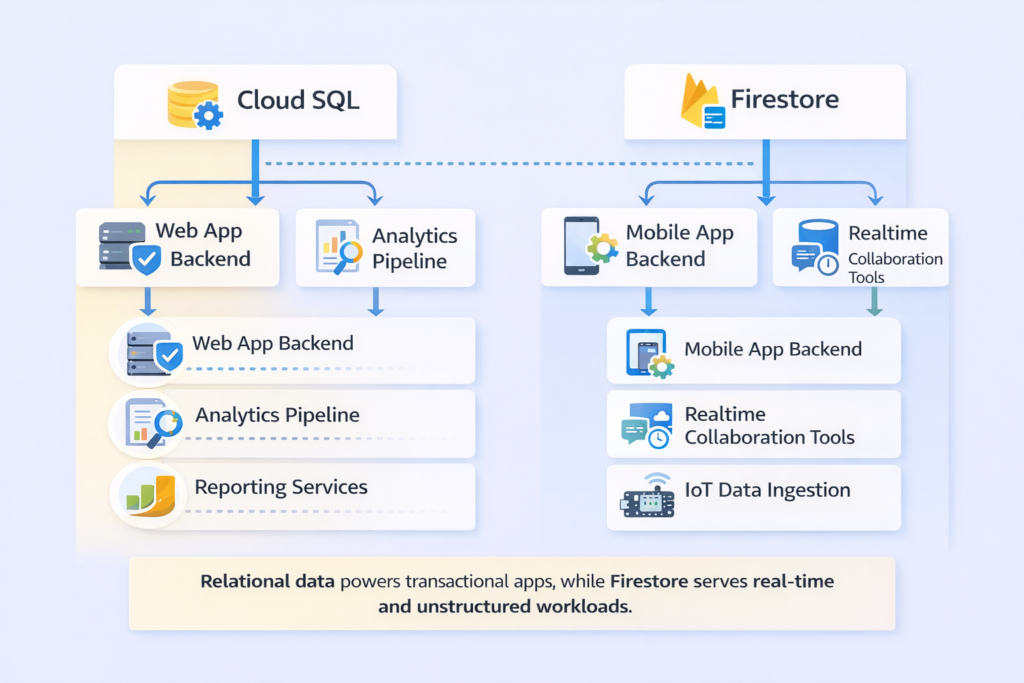
This visual shows relational data powering transactional apps while Firestore serves real-time and unstructured workloads.
Hands-On Example: Choosing Between Cloud SQL & Firestore
Scenario: You are developing an e-commerce mobile app.
- Use Cloud SQL for:
- Customer accounts, orders, inventory – structured relational data.
- SQL queries for reporting and analytics.
- Use Firestore for:
- Real-time notifications (order status updates).
- User shopping cart session storage (document-based).
- Offline-first access for mobile users.
Hybrid Approach: Many GCP applications combine Cloud SQL and Firestore to optimize structured and real-time unstructured data handling.
Advanced Features & Best Practices
- Cloud SQL
- High Availability: Enable multi-zone replication.
- Performance Tuning: Indexing, query optimization, and monitoring CPU usage.
- Security: Use VPC private IP, SSL connections, and IAM integration.
- Firestore
- Index Management: Create composite indexes for advanced queries.
- Data Modeling: Design collections to reduce read/write costs.
- Security Rules: Fine-grained access control for documents and collections.
At Curiosity Tech we provide exercises to compare performance, scalability, and cost trade-offs between Cloud SQL and Firestore, helping engineers make informed architectural decisions.
Conclusion
Mastering GCP databases requires understanding when to use relational Cloud SQL versus NoSQL Firestore, knowing best practices for security, scaling, and performance, and designing hybrid architectures for real-world applications. Engineers who master both database paradigms can confidently architect robust, scalable, and secure cloud applications.
Curiosity Tech guides cloud engineers through practical labs, scenario-based learning, and hands-on projects, ensuring you don’t just know databases theoretically, but can apply them effectively in real enterprise environments.