

As AI careers boom in 2025, two roles dominate conversations: AI Engineer and Machine Learning (ML) Engineer. Both are highly paid, highly in-demand, and deeply interconnected — but they are not the same.
This blog unpacks the differences, overlaps, required skills, career paths, salaries, and industry trends — a must-read for beginners plotting their journey toward becoming AI professionals.
At CuriosityTech (Nagpur-based AI hub), where learners train in TensorFlow, PyTorch, and real-world projects, one of the most common questions is: “Should I become an AI Engineer or an ML Engineer?” Today, let’s answer that.
1. Setting the stage
Before diving into roles, let’s clarify the hierarchy:
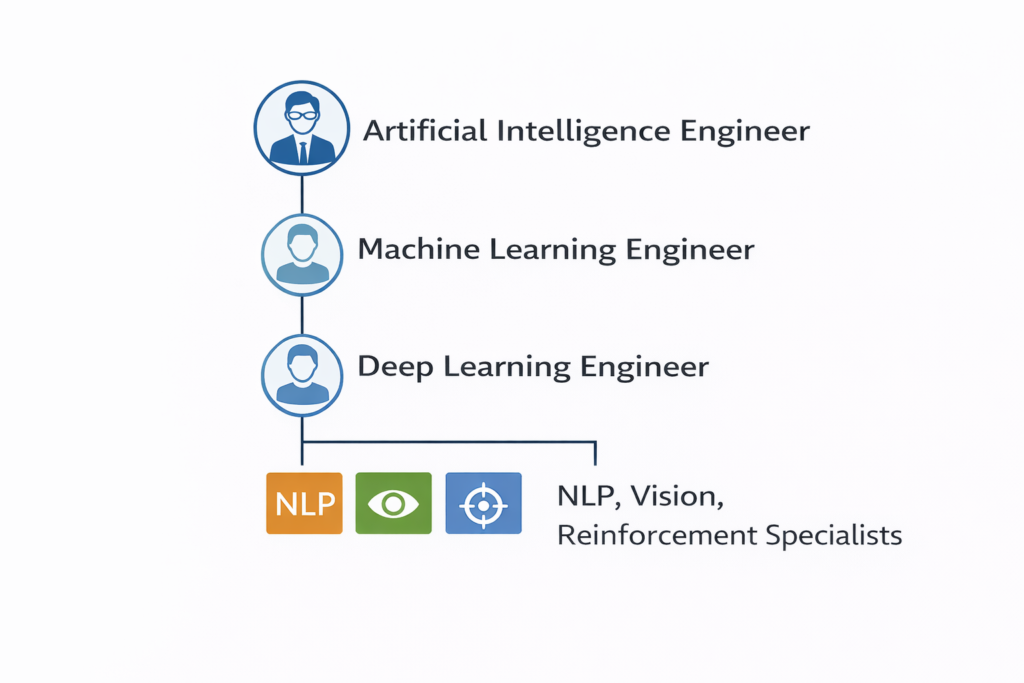
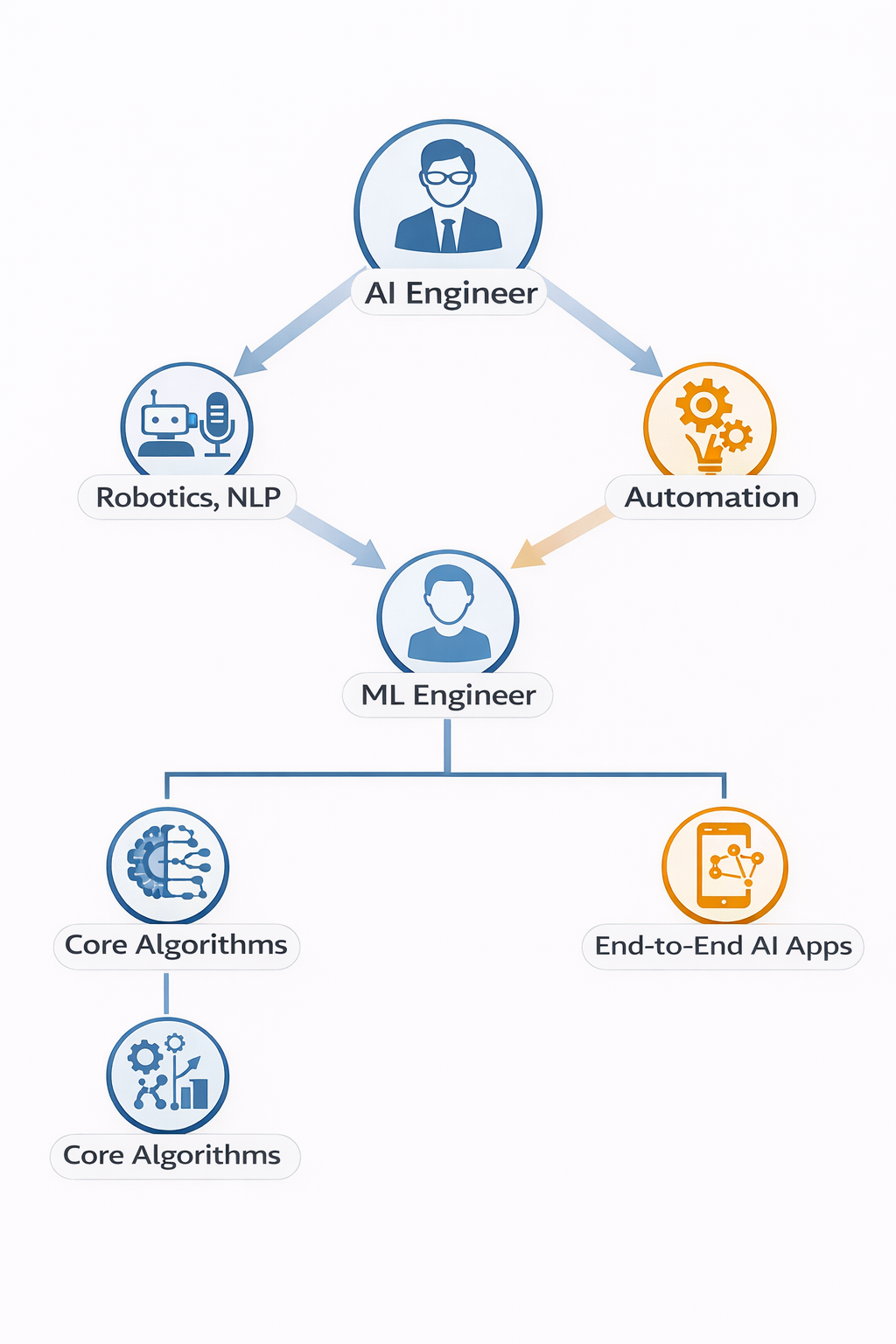
- AI Engineer: Broader scope, works across AI systems including ML, NLP, robotics, and symbolic AI.
- ML Engineer: Narrower but deeper, focusing on building machine learning pipelines, models, and optimization.
2. Key Differences (Comparison Table)
| Dimension | AI Engineer | Machine Learning Engineer |
| Scope | End-to-end AI systems (vision, speech, robotics, automation) | Focuses on ML algorithms, data pipelines, and model training |
| Core Skills | AI frameworks, ML, deep learning, NLP, cloud deployment, robotics | ML algorithms, data preprocessing, optimization, ML lifecycle |
| Programming Languages | Python, Java, C++, R, SQL, TensorFlow, PyTorch | Python, R, TensorFlow, Scikit-Learn, PyTorch |
| Primary Tools | TensorFlow, PyTorch, OpenCV, NLP libraries, ROS, cloud AI platforms | TensorFlow, Scikit-Learn, PyTorch, MLflow |
| End Deliverables | AI-powered apps, chatbots, robots, automation systems | Optimized ML models, APIs for predictions, scalable pipelines |
| Business Impact | Broad — automation, intelligence, robotics | Narrow — data-driven decision-making |
| Career Progression | AI Scientist, AI Architect, Robotics Lead | Senior ML Engineer, Applied Scientist, Research Engineer |
3. Industry Storytelling
Imagine a healthcare startup in Nagpur building an AI-driven diagnostic system:
- The AI Engineer :- Designs the overall system voice-enabled patient interface, vision model for scans, integration with hospital databases, and deployment on cloud platforms like AWS or Google Vertex AI.
- The Machine Learning Engineer :- Focuses on the core predictive model cleaning patient data, training ML algorithms to detect disease patterns, and fine-tuning hyperparameters for accuracy
At Curiosity Tech, students often simulate this by working on projects like X-ray image classification (ML engineering side) and then integrating it into a voice-enabled chatbot for doctors (AI engineering side).
4. Skills Breakdown
AI Engineer Skills
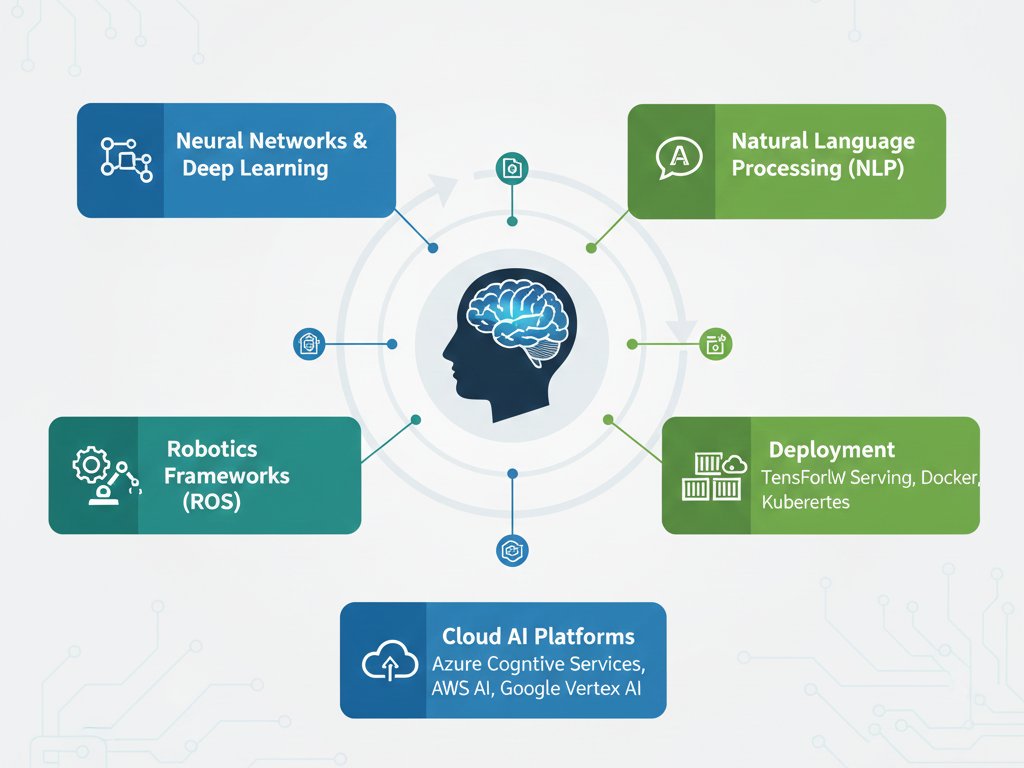
- Neural networks & deep learning
- Natural Language Processing (NLP)
- Robotics frameworks (ROS)
- Deployment: TensorFlow Serving, Docker, Kubernetes
- Cloud AI platforms (Azure Cognitive Services, AWS AI, Google Vertex AI)
ML Engineer Skills
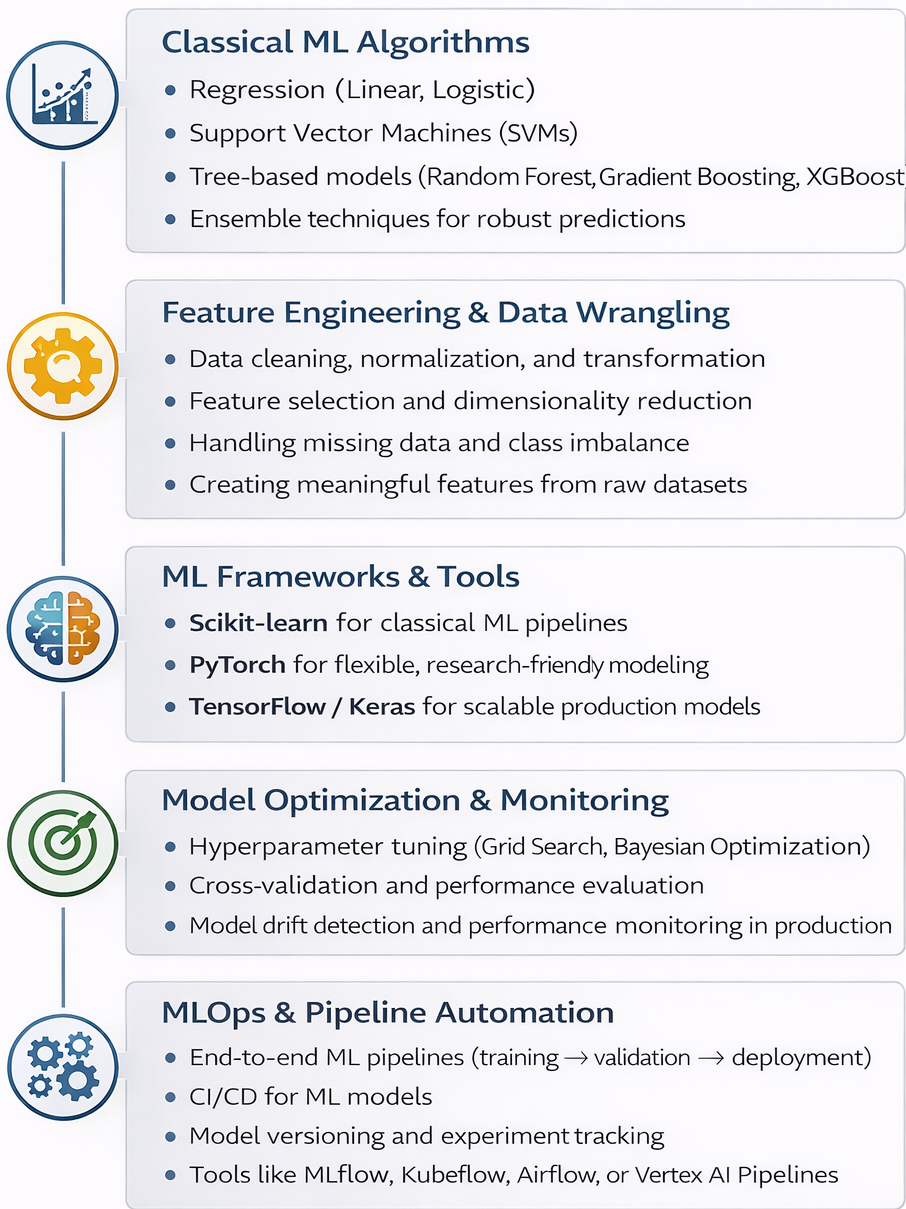
- Classical ML algorithms (regression, SVMs, ensembles)
- Feature engineering and data wrangling
- ML frameworks (Scikit-learn, PyTorch, TensorFlow)
- Model optimization & monitoring
- MLOps and pipeline automation
5. Career Roadmap (How to Become Each)
1 – Build a Strong Foundation
- Mathematics: Linear algebra, probability, calculus
- Programming: Python mastery
- Data handling: SQL, Pandas, NumPy
2 – Choose Your Path
- If you love building end-to-end AI systems, robotics, NLP, automation → AI Engineer
- If you love optimizing models, working with data pipelines, and algorithms → ML Engineer.
3 – Tools & Frameworks
- AI Engineer: Add cloud AI tools, robotics kits, NLP APIs.
- ML Engineer: Focus more on MLflow, data pipelines, hyperparameter tuning.
4 – Projects
- AI Engineer: Build a chatbot + integrate it with speech recognition + deploy on the web.
- ML Engineer: Train a recommendation engine or credit scoring model with millions of rows.
5 – Certifications & Mentorship
- Platforms like CuriosityTech guide learners with certifications and interview training, whether you’re aiming for AI or ML engineering jobs.
6. Salary & Job Market in 2025
| Region | AI Engineer Avg Salary (2025) | ML Engineer Avg Salary (2025) |
| India | ₹15–28 LPA | ₹12–22 LPA |
| USA | $120k–$160k | $110k–$145k |
| Europe | €90k–€130k | €80k–€120k |
Both roles enjoy double-digit growth in demand, especially in healthcare, finance, robotics, and autonomous systems.
7. Visual Infographic (Textual)
8. Human Touch
During mentoring sessions at CuriosityTech (contact: +91-9860555369), students often ask: “What if I choose the wrong path?”
The truth is: you can transition. Many ML engineers become AI engineers after gaining deployment and robotics skills. Conversely, AI engineers often return to ML fundamentals when optimizing models.
What matters most is starting, building projects, and learning continuously.
Conclusion
The choice between becoming an AI Engineer or an ML Engineer isn’t about superiority; it’s about your interest and career goals. AI engineers think broadly about systems and integration, while ML engineers think deeply about algorithms and data pipelines.
If you’re unsure, start with machine learning fundamentals. From there, expand into AI specializations. And remember, platforms like CuriosityTech in Nagpur provide mentorship, projects, and industry pathways that ensure you’re not navigating this decision alone.