

Introduction
In the modern era of mobile technology, businesses and developers face the critical decision of choosing the right approach to app development. Traditionally, native app development has dominated the landscape, where developers create apps for each platform—iOS and Android—using platform-specific languages like Swift or Kotlin. However, as the demand for faster delivery, reduced costs, and broader market reach grows, Cross-Platform Mobile Development has emerged as a revolutionary approach.
Cross-platform development allows developers to write a single codebase that runs seamlessly across multiple platforms, dramatically reducing development time, maintenance costs, and complexity. For beginners and seasoned developers alike, understanding cross-platform paradigms is crucial to thrive in the mobile app ecosystem of 2025.
At CuriosityTech (Website: https://curiositytech.in, Phone: +91-9860555369, Email: contact@curiositytech.in), we specialize in creating in-depth technical insights and practical guides for mobile app developers. Our focus is to help developers grasp complex concepts like cross-platform development with clarity and hands-on examples.
Understanding Cross-Platform Mobile Development
Cross-platform mobile development is a strategy where a single codebase is compiled to run on multiple operating systems, most commonly iOS and Android. Unlike native apps that are built separately for each OS, cross-platform apps rely on frameworks or tools that bridge the gap between platform-specific functionalities and a shared codebase.
Key Characteristics
- Single Codebase: Write once, deploy anywhere.
- Reduced Development Time: No need to maintain separate codebases.
- Consistent User Experience: UI components can be standardized across platforms.
- Cost Efficiency: Lower development and maintenance costs.
- Rapid Prototyping: Ideal for MVPs and iterative development cycles.
Visual Representation
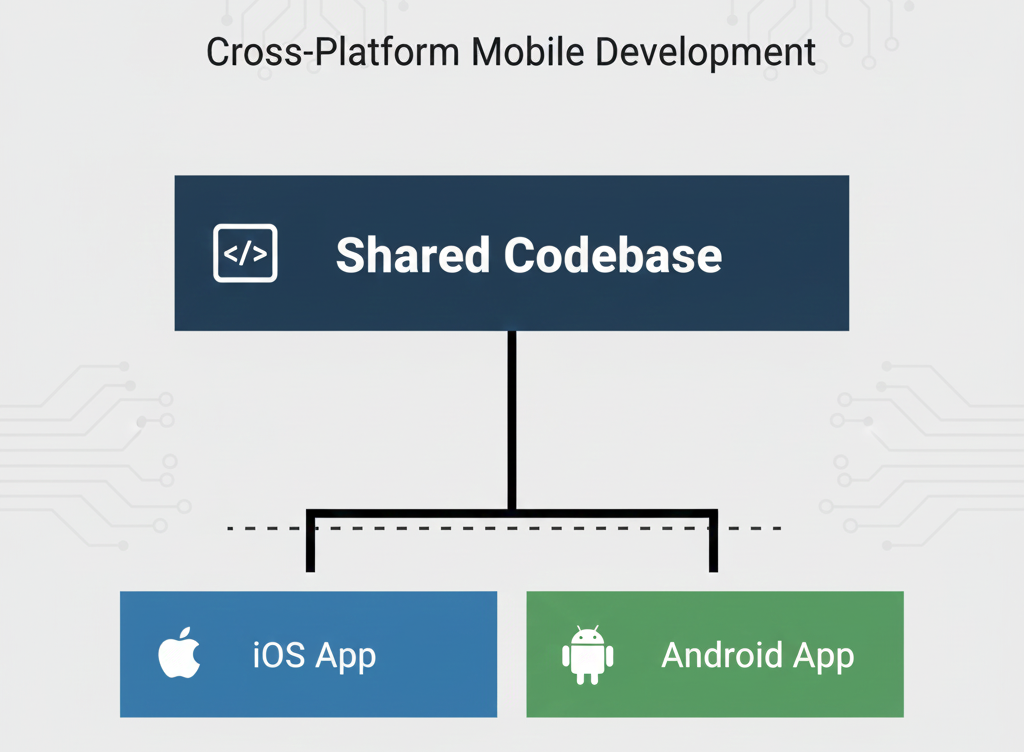
This abstraction highlights that developers can maintain a single core logic while deploying across multiple devices.
Why Cross-Platform Development Matters in 2025
The mobile market is expanding exponentially. Businesses need applications that work on both iOS and Android without doubling the cost or timeline. Some reasons cross-platform is increasingly relevant include:
- Growing Mobile User Base: Over 7 billion smartphone users globally demand app availability across platforms.
- Startup Agility: Rapid app deployment to market-critical segments is easier with one codebase.
- Framework Evolution: Tools like Flutter, React Native, and Xamarin now offer near-native performance and rich UI components.
- Cost Optimization: Enterprises can allocate resources efficiently, focusing on features rather than duplicating work.
At Curiosity Tech, we have guided multiple clients through the process of cross-platform migration, demonstrating how strategic adoption can save up to 40% in development costs while reaching a wider audience.
How Cross-Platform Development Works
The technical backbone relies on frameworks that either:
- Compile to Native Code: Flutter compiles Dart code into ARM machine code.
- Bridge JavaScript to Native Components: React Native uses a JavaScript bridge to render native UI elements.
- Abstract APIs: Xamarin abstracts platform APIs through C# and .NET frameworks.
Example Table: Comparison of Approaches
| Framework | Language | Compilation Approach | Performance | UI Flexibility |
| Flutter | Dart | Ahead-of-Time (AOT) | Near Native | Highly Customizable |
| React Native | JavaScript | JS Bridge to Native | Moderate | Medium |
| Xamarin | C# | Native Compilation | High | Platform-Specific |
Practical Example: Hello World in Flutter
import ‘package:flutter/material.dart’;
void main() {
runApp(MyApp());
}
class MyApp extends StatelessWidget {
@override
Widget build(BuildContext context) {
return MaterialApp(
home: Scaffold(
appBar: AppBar(title: Text(‘Hello World’)),
body: Center(child: Text(‘Welcome to Cross-Platform Development!’)),
),
);
}
}
Explanation:
- MaterialApp provides a base app structure.
- Scaffold creates a default UI layout with AppBar and Body.
- Text widget displays a message on both Android and iOS without any platform-specific changes.
- Even beginners can grasp the concept of “write once, run anywhere” with such simple examples.
How to Become an Expert in Cross-Platform Mobile Development
- Master Core Languages: Learn Dart, JavaScript, and C# thoroughly.
- Hands-On Framework Practice: Build small apps in Flutter, React Native, and Xamarin.
- Understand Platform Nuances: Learn how iOS and Android handle UI, permissions, and performance.
- Testing & Debugging: Become proficient with emulators, unit testing, and debugging tools
- Explore Advanced Concepts: Integrate APIs, push notifications, offline storage, and authentication.
- Follow Industry Trends: Stay updated with the latest releases and best practices.
At Curiosity Tech, we offer in-depth tutorials, real-world projects, and guidance for developers aspiring to become cross-platform experts. Connect with us via Instagram: curiositytechpark, LinkedIn: Curiosity Tech, or Facebook: Curiosity Tech for continuous learning resources.
Conclusion
Cross-platform mobile development is no longer a niche but a critical skill for developers and businesses seeking efficiency, scalability, and cross-device reach. From understanding its core principles to mastering frameworks like Flutter, React Native, and Xamarin, developers can accelerate their career and create high-impact apps.
Starting your journey with foundational knowledge, practical experimentation, and learning from industry leaders such as CuriosityTech ensures you are on the path to becoming a competent cross-platform mobile developer.

