Introduction (Compliance & Ethics-Focused Style)
In 2025, businesses rely on massive amounts of data to drive decisions, yet misuse of data can lead to legal, reputational, and financial consequences. For data analysts, understanding ethics and privacy is as critical as technical skills.
Imagine a Nagpur-based e-commerce company analyzing customer purchase data. Using personal data without consent or sharing insights without proper anonymization can violate privacy laws like GDPR, India’s PDP Bill, and sector-specific regulations.
At CuriosityTech.in, learners are trained to balance analytics excellence with ethical responsibility, ensuring that insights are actionable, legal, and respectful of user privacy.
Step 1: Core Principles of Data Ethics
- Transparency: Be clear about data collection, processing, and purpose
- Consent: Obtain explicit consent before using personal data
- Anonymization: Remove personally identifiable information (PII) where possible
- Accuracy: Ensure data integrity and correct analysis
- Accountability: Analysts should document decisions and maintain responsibility for insights
- Fairness: Avoid biases that discriminate against any group
- Security: Protect sensitive data from unauthorized access
Step 2: Key Data Privacy Regulations
| Regulation / Law | Scope / Requirement | Relevance to Analysts |
| GDPR (EU) | Personal data protection, consent, data breach notifications | Must anonymize EU customer data |
| PDP Bill (India) | Governs storage, processing, and consent of personal data | Local compliance for Indian companies |
| HIPAA (Healthcare, USA) | Protects patient data | Required when handling healthcare data |
| CCPA (California, USA) | Consumer privacy, right to access/deletion | Impacts cross-border US customers |
| Sector-Specific Guidelines | Banking, Telecom, Retail regulations | Follow domain-specific standards |
Step 3: Data Handling Framework
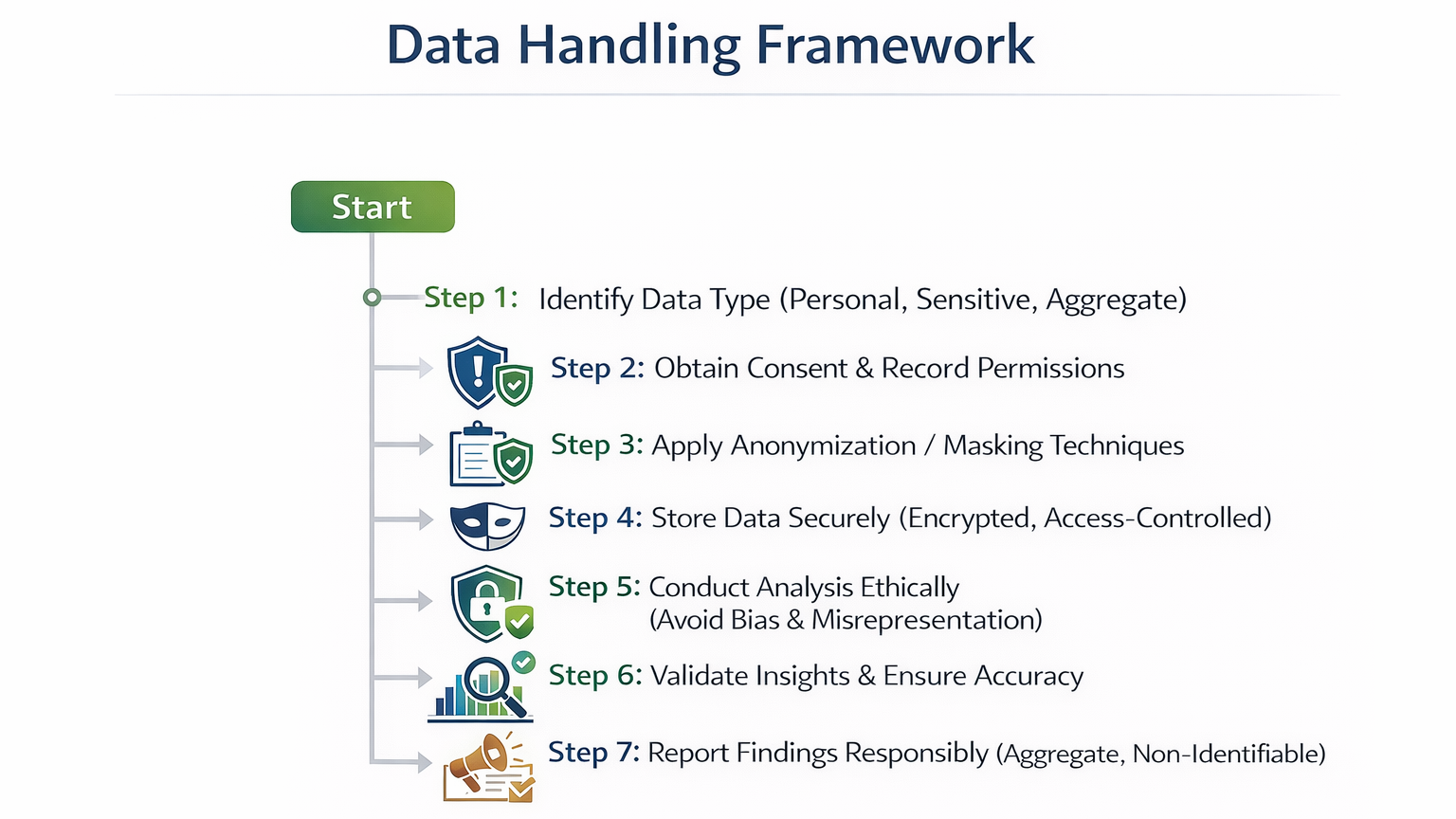
Techniques:
- Data Masking: Replace sensitive info with pseudonyms
- Encryption: Protect data in storage and transit
- Differential Privacy: Introduce statistical noise to protect individuals
- Audit Logs: Track access and changes for accountability
Step 4: Real-World Use Cases
- Customer Analytics:
- Analyze purchasing trends without exposing PII
- Provide segment-based insights for targeted marketing
- Healthcare Analysis:
- Study patient treatment outcomes without storing personal identifiers
- Use anonymized datasets for predictive modeling
- Employee Data Analysis:
- Aggregate HR data for performance insights
- Avoid publishing individual-level sensitive information
Outcome: Businesses gain actionable insights while maintaining trust and legal compliance.
Step 5: Table – Ethical Challenges & Preventive Measures
| Challenge | Example | Preventive Measure |
| Unintended Bias | Model favors male customers | Test for bias, balance dataset |
| Data Breach / Leak | Unauthorized access to customer PII | Encryption, access control, audit logs |
| Consent Violation | Using data without user permission | Collect explicit consent, document approvals |
| Misinterpretation of Data | Misleading charts or conclusions | Peer review, validation, transparency |
| Inadequate Anonymization | Revealing identities through combination of features | Apply masking, aggregation, differential privacy |
Step 6: Visualization & Communication Tips
- Aggregate Data: Show trends by group, not individuals
- Use Anonymized Identifiers: Replace names or IDs with pseudonyms
- Highlight Ethical Decisions: Include notes on consent and privacy
- Dashboards: Include security & privacy disclaimers for internal stakeholders
Example: Nagpur retail dashboard shows total revenue by age group and region, without revealing individual customer purchases.
Step 7: Common Pitfalls
- Neglecting local or international privacy laws → legal consequences
- Sharing raw data externally without anonymization → privacy violation
- Ignoring biases in analysis → unfair business decisions
- Failing to document consent and processing steps → accountability issues
- Over-collecting unnecessary personal data → increases risk
Solution: Analysts should integrate ethical review at every stage of data handling, from collection → analysis → reporting.
Step 8: Tips to Master Data Ethics
- Stay updated with global and local regulations
- Implement privacy by design principles
- Maintain documentation for all datasets and consents
- Conduct bias testing for models and visualizations
- Use tools and frameworks to enforce ethical analytics
At CuriosityTech.in, learners in Nagpur practice ethical analytics scenarios, gaining practical understanding of data privacy, consent, and bias mitigation
Infographic Description – “Ethical Data Analysis Pipeline”
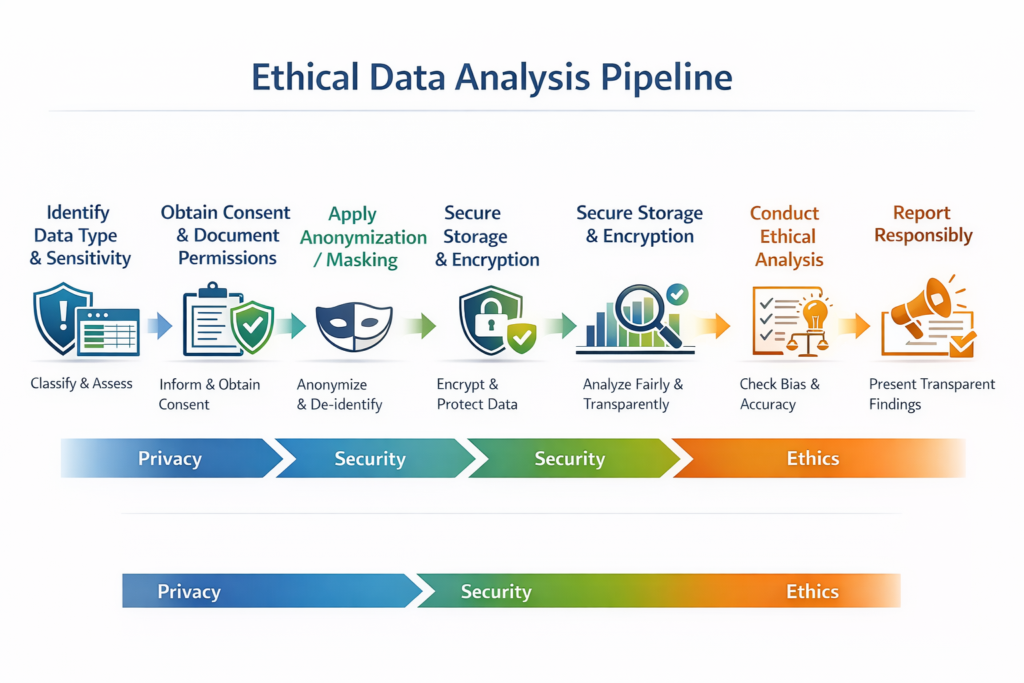
- Stage 1: Identify Data Type & Sensitivity
- Stage 2: Obtain Consent & Document Permissions
- Stage 3: Apply Anonymization / Masking
- Stage 4: Secure Storage & Encryption
- Stage 5: Conduct Ethical Analysis
- Stage 6: Validate Insights & Remove Bias
- Stage 7: Report Responsibly
Visualize as a stepwise compliance pipeline, highlighting the integration of privacy and ethics into all stages of analytics.
Conclusion
In 2025, data analysts must balance technical skills with ethical responsibility. Respecting privacy, ensuring consent, anonymizing sensitive information, and avoiding biases are essential for trustworthy, actionable insights.
At CuriosityTech.in, learners in Nagpur develop hands-on expertise in ethical analytics, combining SQL, Python, Excel, and BI tools while adhering to privacy and compliance standards. Contact +91-9860555369 or contact@curiositytech.in to start mastering data ethics and privacy for modern analytics roles.