
Introduction
Landing a role as a Google Cloud Engineer requires not only hands-on expertise and certifications but also strong interview preparation. Interviews often test technical skills, problem-solving, design thinking, and real-world scenario handling.
At Curiosity Tech , engineers are trained to master GCP fundamentals, advanced services, architecture design, and interview readiness—ensuring they confidently tackle technical and behavioral questions.
Core Areas Typically Covered in GCP Interviews
| Domain | Key Topics |
| Cloud Fundamentals | Projects, billing, regions/zones, IAM basics |
| Compute & Networking | Compute Engine, GKE, Cloud Run, VPC, Load Balancing, Subnets |
| Storage & Databases | Cloud Storage, BigQuery, Cloud SQL, Spanner, Firestore |
| Serverless & DevOps | Cloud Functions, Cloud Build, Artifact Registry, CI/CD pipelines |
| Security & IAM | Roles, policies, VPC Service Controls, encryption, auditing |
| AI/ML & Data Analytics | Vertex AI, BigQuery ML, AutoML, data pipelines |
| Monitoring & Troubleshooting | Cloud Monitoring, Logging, Alerts, AIOps |
| Design & Architecture | High availability, multi-region deployments, disaster recovery, cost optimization |
Most Common Interview Questions (With Detailed Answers)
1. What is Google Cloud Platform, and what are its core services?
Answer: Google Cloud Platform (GCP) is a suite of cloud services including compute, storage, networking, databases, AI/ML, analytics, and DevOps tools.
- Compute: Compute Engine, GKE, Cloud Run, App Engine
- Storage & Databases: Cloud Storage, BigQuery, Cloud SQL, Spanner, Firestore
- Networking: VPC, Cloud Load Balancer, Cloud CDN, Cloud NAT
- AI/ML: Vertex AI, AutoML, BigQuery ML
- DevOps & Monitoring: Cloud Build, Deployment Manager, Cloud Monitoring, Logging
GCP allows scalable, secure, and high-performance cloud-native applications.
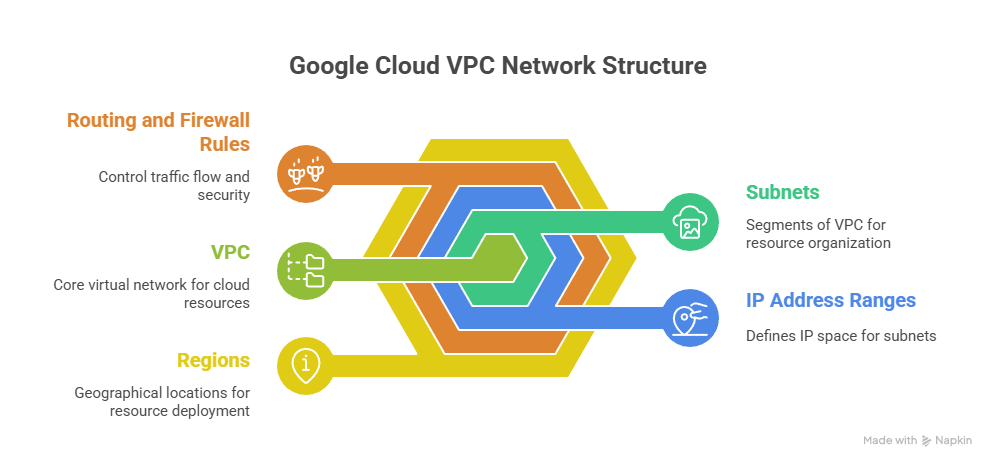
2. Explain VPC and Subnets in GCP.
Answer:
3. What is Cloud Spanner, and when would you use it?
Answer:
- Cloud Spanner is a globally distributed, strongly consistent relational database.
- Use Cases: High-availability applications, global transaction systems, financial services.
- Key Benefits :
- Horizontal scalability
- Multi-region replication
- ACID-compliant transaction
4. How do you implement CI/CD in GCP?
Answer:
- Tools Used: Cloud Build, Artifact Registry, Deployment Manager, GitHub Actions
- Steps:
- Code pushed to version control (e.g: Github)
- Cloud build triggers automated pipeline
- Build & test artifacts stored in Artifact Registry
- Deploy to GKE, Cloud Run or App Engine
- Best Practice: Integrate automated tests, security checks, and rollback mechanisms.
5. How do you ensure high availability for multi-region applications?
Answer:
- Active-Active Deployment: Deploy services across multiple regions, distribute traffic using Global HTTP(S) Load Balancer.
- Active-Passive Deployment: Primary region active, secondary standby for failover.
- Data Replication: Use Cloud Spanner or Cloud SQL HA for cross-region replication.
- Observability: Cloud Monitoring, Logging, and alerts for proactive issue detection.
6. Explain IAM roles in GCP.
Answer:
- IAM (Identity and Access Management) controls access to GCP resources.
- Roles:
- Basic Roles : Owner, Editor, Viewer
- Predefined Roles : Specific access for services (e.g: BigQuery Admin)
- Custom Roles : Tailored permissions for organisation requirements
- Best Practices: Apply least privilege principle and use service accounts for automated workflows.
7. How would you troubleshoot a high-latency application in GCP?
Answer:
- Step 1: Check Cloud Monitoring dashboards for CPU, memory, and network metrics.
- Step 2: Review Cloud Logging for errors or failed requests.
- Step 3: Inspect load balancer and network latency using packet capture or tracing.
- Step 4: Optimize work loads, scale GKE pods, Cloud Run instances, or database queries.
- Step 5: Implement caching using Cloud CDN or Redis if needed.
Scenario-Based Questions
Scenario: An e-commerce site experiences downtime in one region.
- Answer Approach:
- Failover traffic to healthy regions using Global Load Balancer.
- Check Cloud SQL / Spanner Replication & restore data if needed.
- Analyze logs & metrics to determine root cause.
- Implement lessons learned, improve multi-region redundancy.
Interview Preparation Tips
- Hands-On Labs: Qwiklabs, Curiosity Tech projects, and GCP free tier practice.
- Documentation Mastery: Deep dive into GCP services and best practices.
- Mock Interviews: Simulate scenario-based questions and architecture design.
- Portfolio: Maintain real-world project examples with architecture diagrams.
- Behavioral Preparation: Prepare to discuss problem-solving, teamwork, and cloud project experiences.
Conclusion
GCP interviews evaluate both technical depth and real-world problem-solving skills. A well-prepared cloud engineer demonstrates strong understanding of compute, storage, networking, security, DevOps, AI/ML, and monitoring.
At Curiosity Tech , engineers gain hands-on experience, scenario-based training, mock interviews, and project guidance, ensuring they excel in interviews and secure Google Cloud Engineer roles confidently.

