Introduction
Every MERN developer dreams of building powerful React interfaces and scalable Node.js backends. But what most beginners do not realize is that every advanced MERN application is still built on three silent foundations:
HTML, CSS, and JavaScript.
After more than two decades of writing and reviewing web applications for startups, enterprises, and SaaS companies, I can confidently say this:
developers who struggle with React almost always have weak fundamentals in HTML, CSS, and JavaScript.
This is why training environments like CuriosityTech, operating from its learning center in Nagpur and serving students through curiositytech.in, make front-end fundamentals a serious discipline rather than a formality.
Day 4 is where MERN developers stop being tool users and start becoming real web engineers.
1. Why HTML, CSS and JavaScript Still Matter in MERN
React is not a replacement for HTML and CSS.
Node.js is not a replacement for JavaScript logic.
They are extensions of them.
when you write JSX in React, you are writing structured HTML.
When you style React components, you are still writing CSS.
When you handle events, state, and APIs, you are still using JavaScript.
MERN is not new technology — it is a professional way of organizing old fundamentals.
At CuriosityTech, instructors often tell students that frameworks change, but HTML, CSS, and JavaScript remain the language of the browser.
2. HTML: The Structural Skeleton of Every React App
HTML defines:
- What exists on the page
- What elements can be interacted with
- What content search engines read
In React, every component ultimately becomes HTML in the browser. A developer who does not understand semantic HTML will build:
- Poorly accessible websites
- SEO-weak pages
- Broken layouts
Professional MERN developers understand:
- Document flow
- Forms and inputs
- Accessibility tags
- Page structure
This is why CuriosityTech insists on HTML mastery before moving students to React.
3. CSS: The Visual Language of Web Apps
CSS is not just about colors and fonts.
In real applications, CSS controls:
- Responsive layouts
- User experience
- Branding
- Performance
Large React apps depend on:
- Flexbox
- Grid systems
- Component-based styling
- Media queries
Without CSS mastery, even the best React logic looks broken.
4. JavaScript: The Brain of MERN
JavaScript is the only language that runs:
- In the browser
- On the server (Node.js)
- Inside React
- Inside APIs
This makes it the true engine of the MERN stack.
In real projects, JavaScript handles:
- User input
- API requests
- Data validation
- State changes
- Business logic
This is why CuriosityTech focuses heavily on JavaScript logic before introducing frameworks.
How These Three Form MERN Foundations
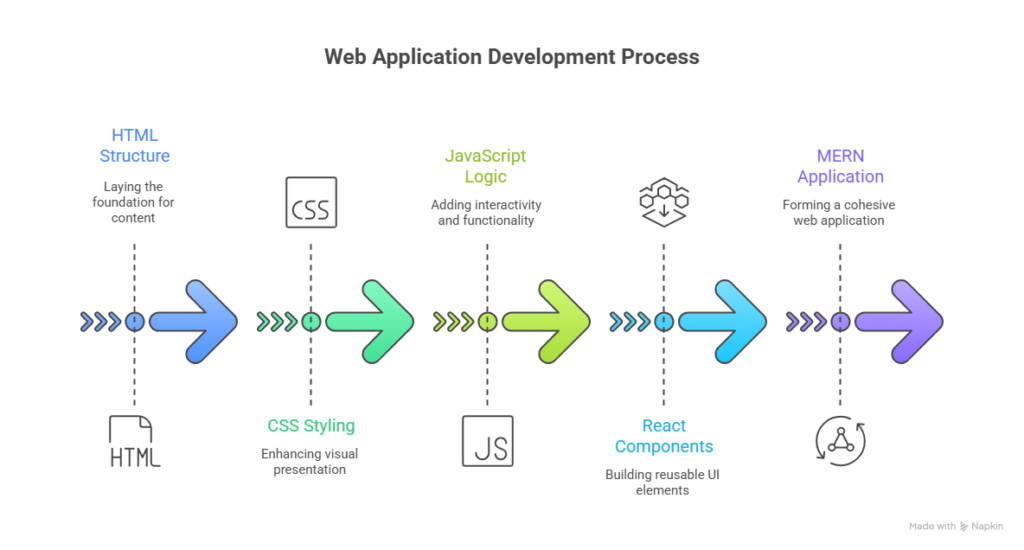
This hierarchy shows why skipping fundamentals breaks everything above it.
Real-World Use in MERN Applications
| Layer | Role in MERN |
| HTML | Component structure |
| CSS | UI and responsiveness |
| JavaScript | Data handling |
| React | UI framework |
| Node | Server logic |
| MongoDB | Data storage |
MERN is not separate from HTML, CSS and JS. It is built on them.
Infographic Description
Title: From HTML to MERN
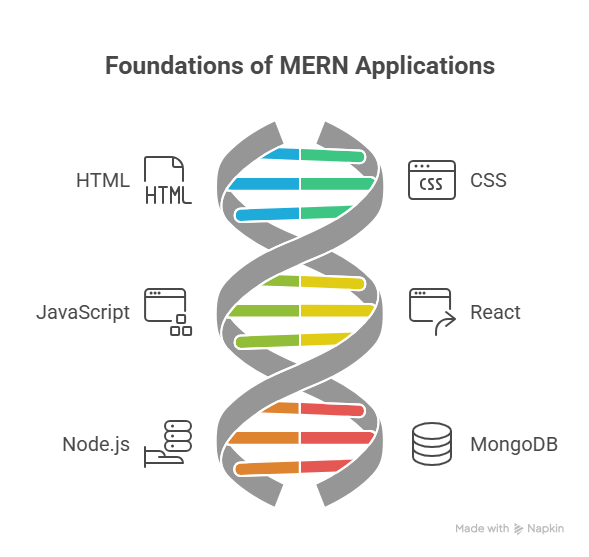
This illustrates how every advanced MERN app is rooted in basic web technologies.
Why CuriosityTech Starts MERN Here
Unlike crash courses that rush into React, CuriosityTech ensures students understand:
- Browser behavior
- Layout mechanics
- JavaScript execution
This is why their MERN students can build stable, scalable applications instead of just copying tutorials.
Conclusion
HTML, CSS, and JavaScript are not beginner topics. They are professional survival skills.
Every MERN developer who masters these three gains:
- Faster debugging
- Better UI control
- Cleaner React code
- Stronger backend logic
This is why Day 4 is one of the most important days in your MERN journey.