Introduction: Why HR Policies & Compliance Are a Manager’s Compass
Imagine trying to steer a ship without a compass — that’s what managing a team without HR policies feels like. Policies are not just documents filed away in some dusty cabinet; they are living frameworks that protect employees, managers, and the organization itself.
As workplaces evolve in 2025, HR compliance has become a critical balancing act: maintaining fairness, protecting legal interests, and empowering employees. Many managers assume compliance is the sole responsibility of HR departments, but the truth is managers are the first line of defense.
At Curiosity Tech in Nagpur, where workforce growth and tech-driven HR solutions intersect, managers are often trained to recognize that policies aren’t barriers — they are enablers. From preventing lawsuits to ensuring healthy workplace culture, mastering HR compliance is a non-negotiable skill.
Core HR Policies Every Manager Should Know
| Policy Area | Why It Matters in 2025 | Manager’s Role |
| Anti-Discrimination & Equal Opportunity | Prevents bias in hiring, promotions, and workplace culture. | Monitor fairness in daily decisions, prevent microaggressions, and report violations. |
| Workplace Safety (OSHA / State Regulations) | Remote + hybrid setups expand safety responsibilities beyond office walls. | Ensure employees working remotely follow ergonomics, safety guidelines, and digital security. |
| Leave & Attendance | Defines sick leave, maternity/paternity benefits, flexible working. | Approve requests fairly, avoid favoritism, and align with legal standards. |
| Compensation & Payroll Compliance | Ensures timely, lawful payments and prevents wage disputes. | Double-check approvals, avoid misclassification of employees vs contractors. |
| Data Privacy & Confidentiality | With AI-driven HR tools, employee data protection is vital. | Prevent data leaks, educate team on responsible tech use. |
| Anti-Harassment Policies | Creates safe workplace free from harassment and bullying. | Be approachable, act swiftly on complaints, avoid retaliation. |
A Hierarchical View of HR Compliance Responsibilities
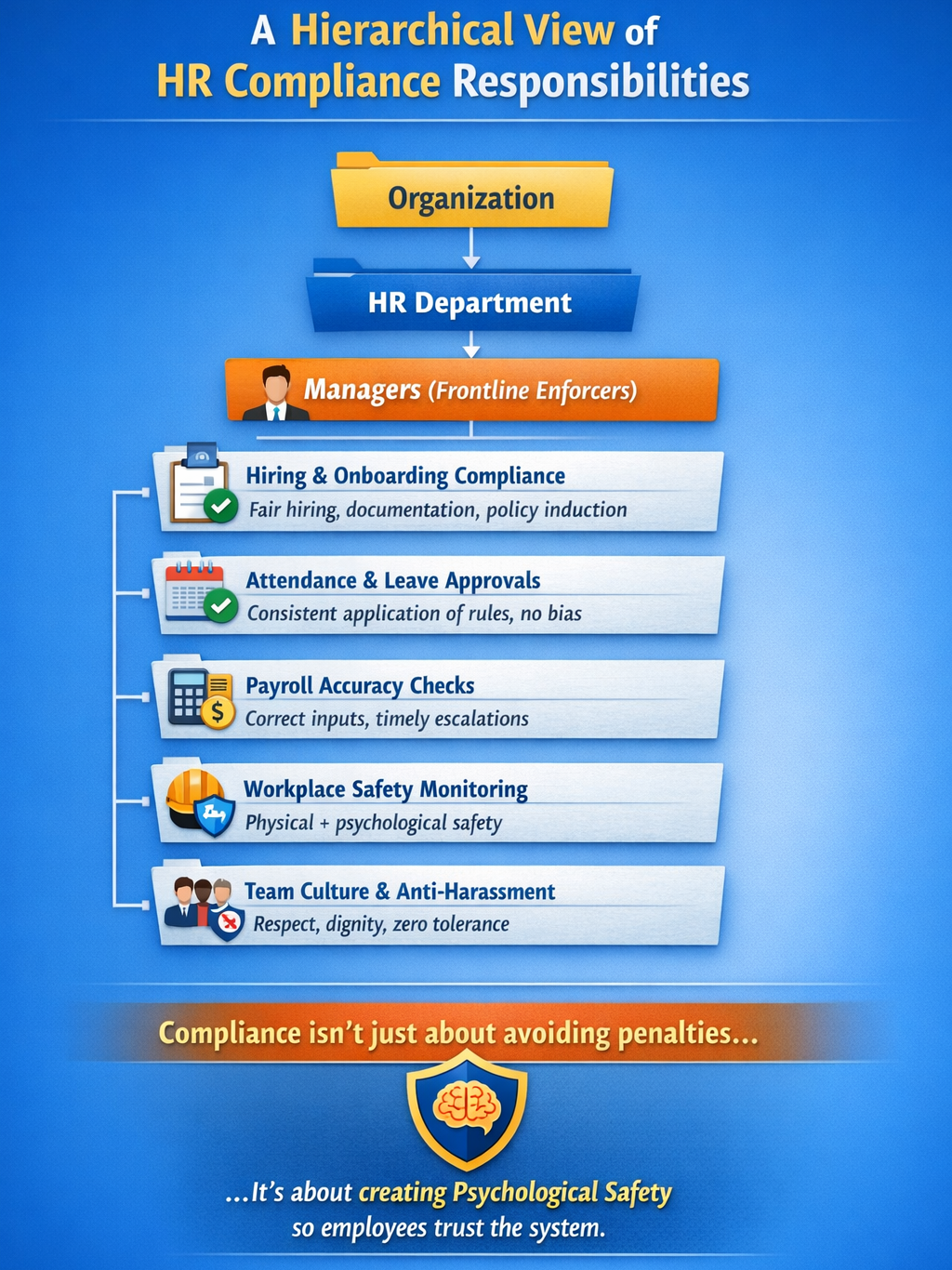
Insight: Compliance is not just about “avoiding penalties.” It’s about creating psychological safety so employees trust the system.
Deep Dive: How Managers Become Experts in HR Compliance
- Legal Acumen Without Being a Lawyer :-
- Managers should understand labor laws at a practical level — not memorizing legislation, but knowing what not to overlook.
- Example: A Curiosity Tech manager noticed an employee being misclassified as a freelancer while working full-time. Correcting it prevented legal risks and built trust.
- Managers should understand labor laws at a practical level — not memorizing legislation, but knowing what not to overlook.
- Document Everything :-
- In 2025, documentation is evidence. Verbal approvals without written proof can sink a company in audits.
- Using HRIS tools (like those deployed at CuriosityTech.in) ensures every action leaves a digital footprint.
- In 2025, documentation is evidence. Verbal approvals without written proof can sink a company in audits.
- Training as a Shield :-
- Regular workshops on compliance transform managers from passive observers into proactive guardians.
- A training session on data privacy at Curiosity Tech once uncovered shadow software usage by a remote team — early detection saved sensitive client data.
- Regular workshops on compliance transform managers from passive observers into proactive guardians.
- Blending Empathy with Enforcement :-
- A strict rule enforcer without empathy creates fear. A lax manager creates chaos. True expertise lies in balancing humanity with accountability.
- A strict rule enforcer without empathy creates fear. A lax manager creates chaos. True expertise lies in balancing humanity with accountability.
Infographic Representation (text-based for blog)
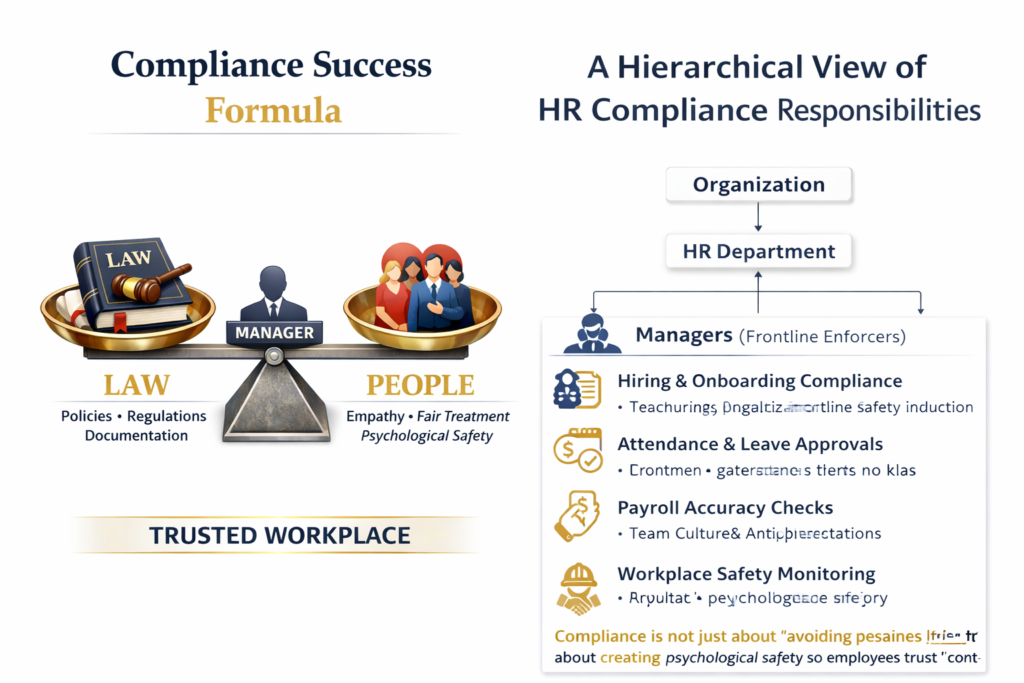
Manager Awareness + Legal Knowledge + Documentation + Empathy = Trusted Workplace
(Visual Suggestion: A scale balancing “Law” on one side and “People” on the other, with “Manager” at the fulcrum.)
Real-World Case Study (Curiosity Tech Example)
At Curiosity Tech, when hybrid working became the norm, leave policies and attendance tracking needed urgent updating. Instead of imposing top-down rules, managers collaborated with employees:
- They used a survey-driven approach to understand challenges.
- Updated policies ensured remote workers could mark attendance via a secure app.
- A feedback loop allowed employees to report compliance difficulties anonymously.
The result? Higher engagement, fewer disputes, and a reputation boost — CuriosityTech.in began receiving LinkedIn recognition for progressive HR practices in 2025.
Practical Tips for Managers
- Never delay action: Compliance delayed is compliance denied.
- Normalize conversations: Discuss HR policies during team meetings, not just induction.
- Use tech wisely: Tools like ATS, HRIS, and payroll systems reduce human error.
- Stay updated: Laws evolve — what was compliant in 2023 may be illegal in 2025.
How Compliance Fuels Career Growth
Managers who excel in HR policies are seen as future HR leaders. Compliance expertise signals strategic maturity — a skill set valued by global organizations. At Curiosity Tech’s HR mentorship workshops, compliance mastery is always highlighted as a pathway to executive leadership.
Conclusion
HR policies and compliance may look like dry paperwork, but in reality, they shape workplace culture, reduce risks, and empower growth. A manager who masters compliance is not just protecting the company — they’re building trust, fairness, and future-proof leadership.
And as organizations like Curiosity Tech (Nagpur, India) demonstrate, compliance-driven management is not about restricting freedom; it’s about creating clarity so creativity thrives without fear.