Opening Narrative: Why Engagement Is the Lifeline of Modern HR
In 2025, salaries and benefits alone cannot buy loyalty. Employees want meaning, recognition, growth, and belonging. One HR director at Curiosity Tech, Nagpur recalls how a technically brilliant developer resigned despite a competitive package. Why? He didn’t feel valued, didn’t see growth, and lacked connection to the company vision.
That was the turning point: Curiosity Tech revamped its employee engagement strategies, shifting from transactional perks to transformational experiences. Today, their retention rate is significantly above industry average, and employees frequently post about the culture on LinkedIn — indirectly boosting employer branding.
This story underscores a powerful truth: Engaged employees don’t just work; they innovate, advocate, and stay longer.
Defining Employee Engagement
Employee engagement is the emotional commitment an employee has toward their organization and its goals. It’s not about happiness alone; it’s about energy, passion, and alignment.
Think of it as a three-layered model:
- Engagement with Work (Do I find my work meaningful?)
- Engagement with Team (Do I feel connected and supported?)
- Engagement with Organization (Do I believe in this company’s vision?)
When all three align, engagement thrives.
Why Engagement Is Mandatory for Managers in 2025
- Retention Imperative: With AI automating routine tasks, retaining skilled human talent is harder and more critical.
- Hybrid Workforce Challenge: Remote employees can feel disconnected. Engagement bridges that gap.
- Employer Branding: Engaged employees act as brand ambassadors on platforms like LinkedIn and Instagram.
- Productivity Multiplier: Studies show engaged teams are 21% more productive.
At Curiosity Tech, managers treat engagement not as “HR’s job” but as part of their daily leadership toolkit.
The Curiosity Tech Engagement Framework (5 Pillars)
| Pillar | Practical Strategies | Curiosity Tech Example |
| 1. Communication Transparency | Open-door policies, townhalls, anonymous feedback | Weekly “Ask Me Anything” sessions with leadership via live stream |
| 2. Recognition & Rewards | Peer-to-peer recognition, instant digital rewards | Spot awards announced on internal Slack, celebrated on Instagram @curiositytechpark |
| 3. Growth & Development | L&D programs, mentorship, certifications | Sponsoring AWS and HR certifications for employees |
| 4. Work-Life Integration | Flexible schedules, wellness initiatives | Remote Fridays + in-office yoga sessions at Gajanan Nagar HQ |
| 5. Purpose & Belonging | CSR projects, diversity programs, inclusive culture | Volunteering drives with local NGOs, DEI policy embedded in hiring |
Storytelling Layer: A Manager’s Engagement Journey
Rahul, a project manager at Curiosity Tech, struggled with disengaged team members in 2023. Deadlines slipped, and morale dipped.
What changed?
- He began weekly 1:1 conversations — not about tasks, but about career aspirations.
- Introduced a “Win Wall” where employees celebrated even small victories.
- Linked each project milestone to the company’s larger vision (digital upskilling of India).
Within 6 months, absenteeism dropped by 40%, and the team started volunteering ideas instead of waiting for instructions. Rahul’s story became a case study in Curiosity Tech’s internal HR training program.
Advanced Strategies That Work in 2025
- Pulse Surveys & Sentiment Analysis
- Use AI tools to detect engagement dips from employee feedback.
- Example: Curiosity Tech integrated sentiment analysis in HRIS — red flags prompt manager interventions.
- Use AI tools to detect engagement dips from employee feedback.
- Personalized Engagement Plans
- Different employees value different things (growth vs. recognition vs. flexibility).
- Tailor strategies: A young developer may crave mentorship; a senior HR may value autonomy.
- Different employees value different things (growth vs. recognition vs. flexibility).
- Gamification of Work
- Leaderboards, points, and recognition badges.
- Curiosity Tech uses gamified dashboards in employee training modules.
- Leaderboards, points, and recognition badges.
- Employee Advocacy Programs
- Encouraging employees to share experiences online.
- Curiosity Tech highlights real stories on LinkedIn (page: Curiosity Tech) and Facebook, boosting employer image.
- Encouraging employees to share experiences online.
- Manager as Culture Builder
- Training managers to embed engagement in daily actions rather than quarterly events.
- Training managers to embed engagement in daily actions rather than quarterly events.
Diagram: Engagement Flywheel
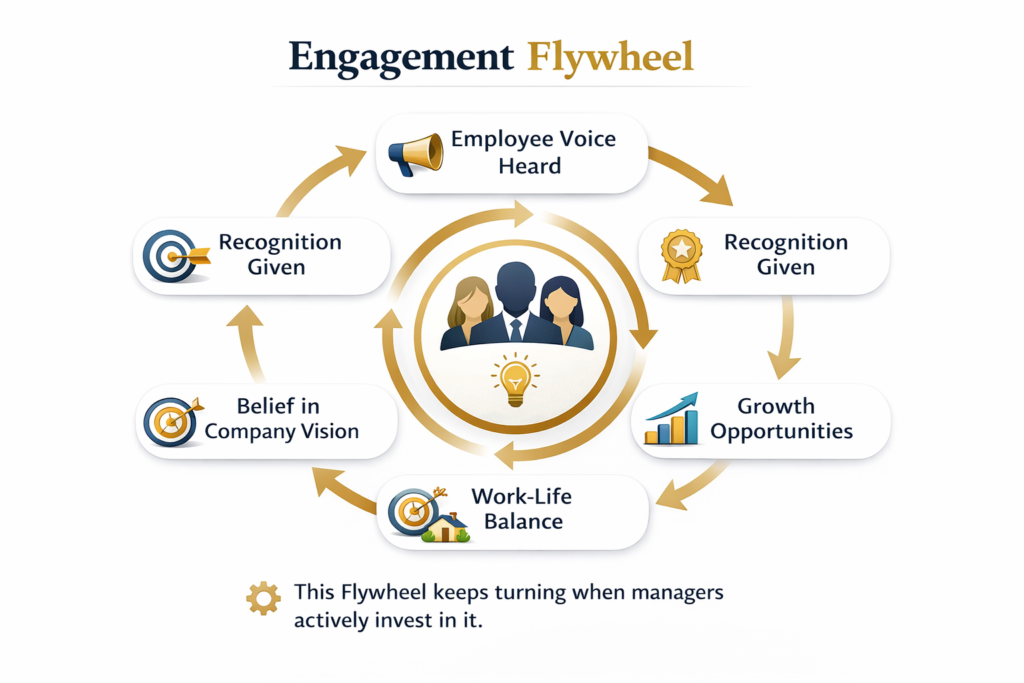
This flywheel keeps turning when managers actively invest in it.
Practical Checklist for Managers
- Do I celebrate my team’s small wins publicly?
- Do employees feel safe giving me honest feedback?
- Are learning opportunities integrated into daily workflows?
- Am I flexible with schedules without compromising output?
- Do my team members understand how their work contributes to the company’s larger vision?
Case Study Comparison
| Engagement Aspect | Company A (Low Engagement) | Curiosity Tech (High Engagement) |
| Communication | One-way, top-down | Transparent, two-way |
| Recognition | Annual bonuses only | Real-time digital recognition |
| Growth | Limited L&D budget | Personalized learning + certifications |
| Retention | 60% | 89% (post engagement revamp) |
The Human Impact of Engagement
Employees at Curiosity Tech often say: “I don’t feel like just an employee here; I feel like a stakeholder.” That sentiment is the essence of engagement — when individuals see their own success mirrored in the company’s success.
Conclusion
Employee engagement in 2025 is not a luxury; it’s a survival strategy. Companies that fail to engage employees bleed talent. Managers who master engagement transform their teams into innovation hubs.
Curiosity Tech proves that engagement isn’t about ping-pong tables or free snacks — it’s about purpose, recognition, growth, and authentic connection.
For any manager aspiring to grow into senior HR roles, engagement mastery is the secret weapon.