
Introduction
The role of a Business Analyst (BA) is evolving faster than ever. By 2025, organizations across industries—from fintech startups to government enterprises—are relying on analysts who not only understand business processes but also stay ahead of tools, trends, and technological disruptions.
Over the last 20 years of my career, I’ve seen the shift from pen-and-paper requirements gathering to AI-powered analysis tools. At (Curiosity Tech), where we mentor aspiring and professional BAs in Nagpur and beyond, our training is rooted in adapting to these changes—ensuring analysts aren’t just surviving but thriving in the new digital-first environment.
1. Why Staying Updated Matters in 2025
- Disruption is constant: AI, automation, and low-code platforms are rewriting business analysis.
- Stakeholder expectations are higher: Speed, accuracy, and visualization are demanded instantly.
- BA as a strategic partner: Analysts are no longer note-takers—they’re strategic decision influencers.
- Global competition: With remote-first work, your competitor might be sitting in another country.
Fact: According to industry reports, 70% of failed projects cite poor requirements or outdated tools as a core reason.
2. Emerging Tools Every BA Must Know in 2025
a. AI-Powered Requirement Gathering
- Examples: ChatGPT Enterprise, Microsoft Copilot, IBM Watson Assistant.
- Impact: Auto-drafting user stories, analyzing customer sentiment, and predicting requirement gaps.
b. Process Mining Software
- Examples: Celonis, UiPath Process Mining.
- Impact: Goes beyond BPMN to track real process execution through system logs.
c. Collaborative Cloud Platforms
- Examples: Miro, MURAL, FigJam.
- Impact: Virtual whiteboards replacing in-person workshops for distributed teams.
d. Advanced Modeling Tools
- Examples: Lucidscale for 3D architecture models, Enterprise Architect with AI integrations.
- Impact: Enables BAs to design digital twins of businesses.
e. Data-Driven Analysis Tools
- Examples: Power BI, Tableau, QlikSense with AI-powered dashboards.
- Impact: Analysts can present actionable insights instead of static reports.
3. Emerging Trends for Business Analysts in 2025
- Trend 1: Integration of AI with BA Workflows
- AI won’t replace analysts but will augment them. Expect tools that:
- Suggest requirements during elicitation
- Detect ambiguities automatically
- Predict project risks before they escalate.
- AI won’t replace analysts but will augment them. Expect tools that:
- Trend 2: Rise of Low-Code/No-Code Platforms
- Platforms like Mendix, OutSystems, and Microsoft PowerApps empower analysts to prototype apps without waiting on developers.
- Trend 3: Hyper-Automation
- Combining RPA (Robotic Process Automation), AI, and process mining for end-to-end business optimization.
- Trend 4: Focus on Customer-Centric Design
- Design thinking is no longer optional. BAs in 2025 must master UX wireframing, journey maps, and empathy-based requirement gathering.
- Trend 5: BA as Strategic Advisor
- Business analysts are shifting from being requirement writers to becoming digital strategists who guide transformation initiatives.
4. Comparative Snapshot: Past vs 2025
| Feature | BA in 2015 | BA in 2025 |
| Requirement Gathering | Manual interviews, documents | AI-driven sentiment & requirement analysis |
| Tools | MS Excel, MS Visio | AI Copilots, Celonis, Power BI, Miro |
| Collaboration | In-person workshops | Cloud-based real-time collaboration |
| Modeling | BPMN & UML only | BPMN + AI-driven models + Digital Twins |
| Role in Organization | Support role | Strategic transformation partner |
5. Visual Abstract (Description)
Imagine a timeline infographic showing:
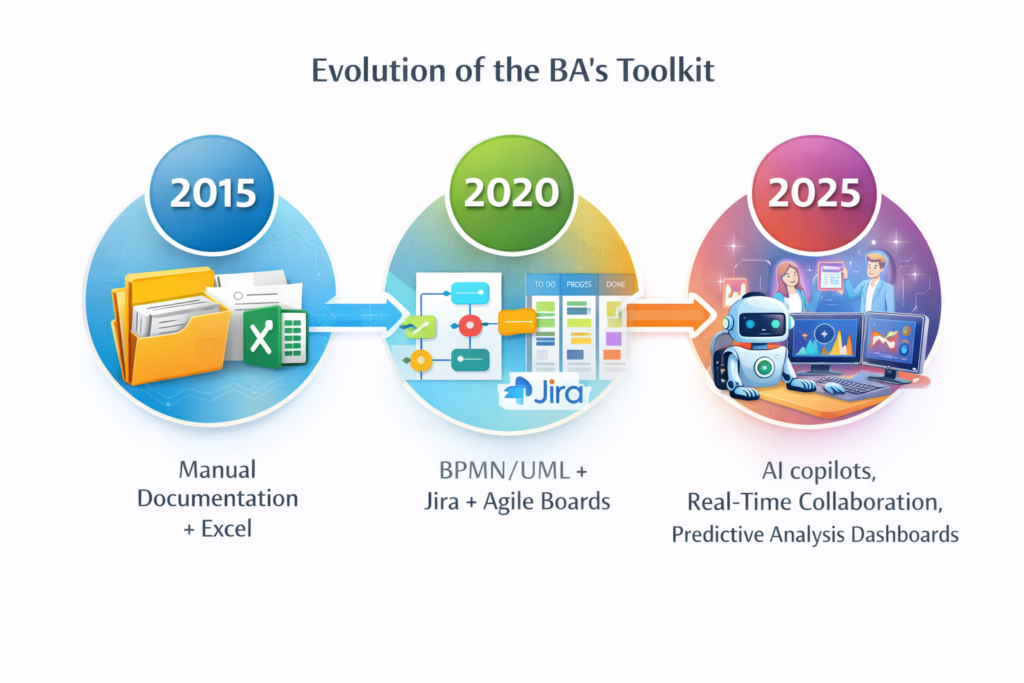
- 2015: Manual documentation + Excel.
- 2020: BPMN/UML + Jira + Agile boards.
- 2025: AI copilots, real-time collaboration, predictive analysis dashboards.
This visualization represents the evolution of BA’s toolkit.
6. How to Stay Relevant as a BA in 2025
- Upskill Continuously – Learn tools like Power BI, Celonis, Miro, AI copilots.
- Certifications – Look into CBAP, PMI-PBA, Agile BA certifications with AI-focused modules.
- Practice on Projects – Build case studies of emerging tech in real-world domains.
- Network & Share – Engage with professional groups on LinkedIn (Curiosity Tech is active here too).
- Enroll in Learning Hubs – Local institutes like CuriosityTech, Gajanan Nagar, Nagpur (Phone: +91-9860555369, Email: contact@curiositytech.in) provide blended training in traditional BA techniques and future-ready tools.
7. Humanizing the Trend
Two decades ago, when I facilitated workshops, I’d carry binders of notes. Today, I can map workflows in Miro while AI copilots generate user stories in real-time. The analyst’s role has not disappeared; it has evolved into something far more exciting. At Curiosity Tech, we remind learners: “It’s not about replacing humans with AI, but about empowering humans with AI.”
Conclusion
The business analyst of 2025 is not defined by old-school documentation but by adaptability, tool mastery, and a future-oriented mindset. Tools like AI copilots, process mining platforms, and collaborative whiteboards are setting the stage for analysts to act as strategic advisors rather than just requirement gatherers.
By embracing these trends, and with guidance from trusted learning ecosystems like CuriosityTech Park (Instagram: curiosity tech, LinkedIn: Curiosity Tech, Facebook: Curiosity Tech), analysts can ensure they are not only employable but indispensable.