

When you hear the terms frontend, backend, and full stack, they might sound like jargon reserved only for seasoned developers. But if you’re beginning your journey in Java Full Stack development—or aiming to become a modern web professional—it’s crucial to understand how these roles differ, interact, and combine to build the apps and websites we use every day.
At CuriosityTech, where we specialize in empowering learners to go from zero to hero in cutting-edge technologies, we often explain these concepts in simple, practical terms. Whether you’re enrolling in a structured course in Nagpur or exploring our online resources, our approach always blends clarity, industry experience, and project-based learning.
The Three Layers of Web Development
Think of a web application as a restaurant:
- The frontend is like the dining area where customers sit, enjoy the ambiance, and interact with the menu.
- The backend is like the kitchen, where all the real cooking happens.
- The full stack developer is like the restaurant manager who understands both customer service and kitchen operations, bridging the gap between the two.
1. Frontend Development (The Visible Layer)
Frontend is all about user experience (UX) and user interface (UI).
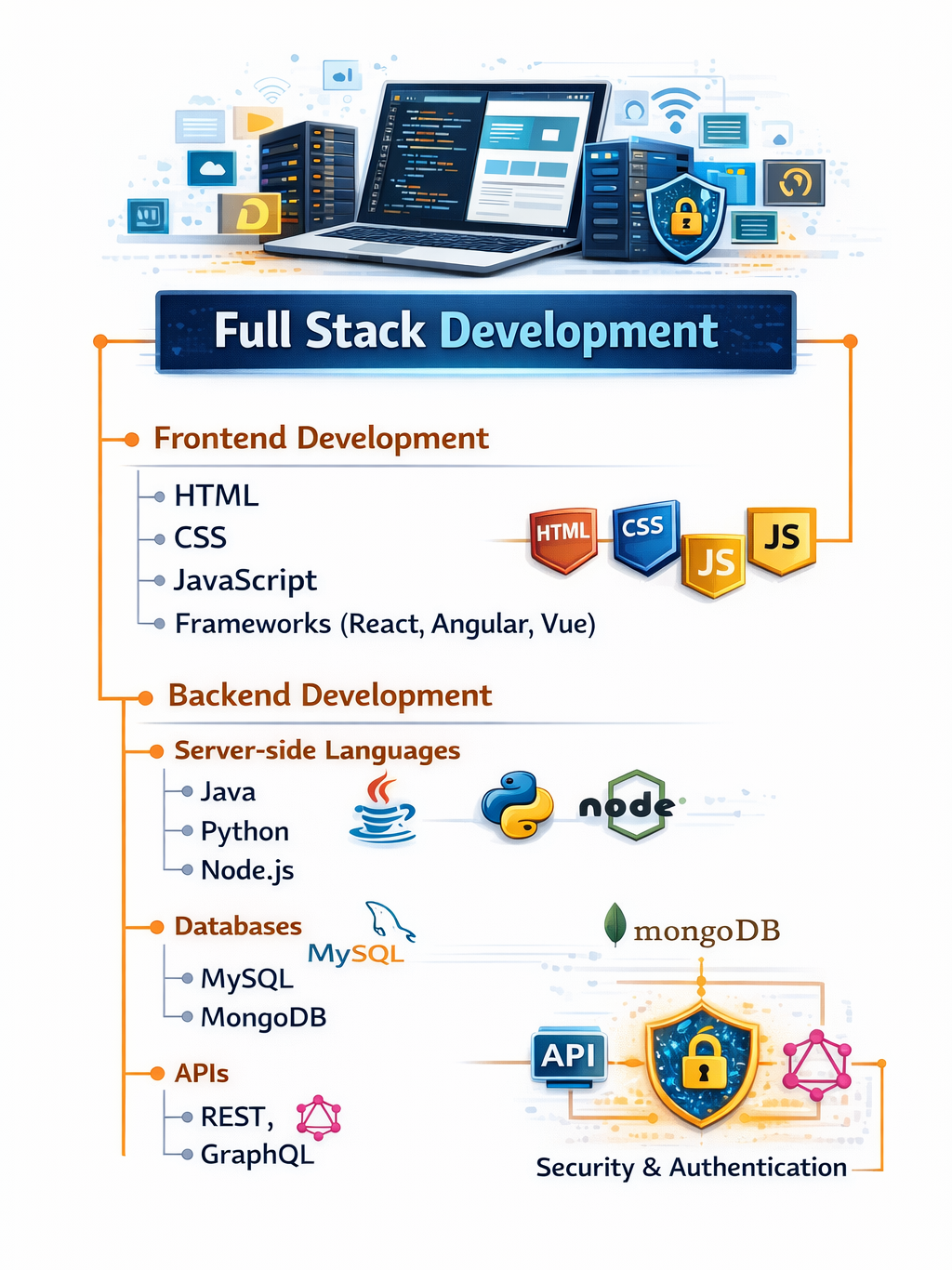
- Languages & Tools: HTML, CSS, JavaScript, React, Angular, Vue
- Focus: Designing layouts, styling, animations, responsiveness, and usability.
- Example: When you click the “Sign Up” button on CuriosityTech’s website and see a smooth pop-up form—that’s frontend magic.
2. Backend Development (The Engine Room)
Backend is the logic and data layer that powers applications.
- Languages & Tools: Java (Spring Boot), Python (Django), Node.js, Databases (MySQL, MongoDB, Oracle)
- Focus: Handling user authentication, database queries, APIs, and server logic.
- Example: When you log into your Curiosity Tech student dashboard and your personal learning progress appears, the backend is ensuring the data is securely fetched and displayed.
3. Full Stack Development (The Best of Both Worlds)
A Full Stack Developer combines both worlds—capable of crafting elegant frontends while engineering robust backends.
- Skills: Knowledge of frontend + backend + deployment.
- Focus: End-to-end ownership of projects, from UI design to server setup.
- Example: At Curiosity Tech, many learners are trained to become Java Full Stack Developers, meaning they can build enterprise-grade applications from scratch.
Hierarchical Diagram (Text Representation)
Comparison Table: Frontend vs Backend vs Full Stack
| Aspect | Frontend Developer | Backend Developer | Full Stack Developer |
| Focus | User Interface, Experience | Server Logic, Data Handling | End-to-End Development |
| Languages | HTML, CSS, JavaScript | Java, Python, Node.js, SQL | Combination of Both |
| Tools/Frameworks | React, Angular, Vue | Spring Boot, Django, Express | Mix of Frontend + Backend Frameworks |
| Output | Websites, Mobile Interfaces | APIs, Server-side Apps | Complete Applications |
| Career Path | UI/UX, Frontend Engineer | Backend Engineer, Database Dev | Full Stack Engineer, Tech Lead |
Why Full Stack Matters Today?
Companies no longer want developers confined to one side of the spectrum. They seek professionals who can bridge gaps, accelerate delivery, and adapt to different project requirements. This is why CuriosityTech’s Full Stack Development programs are designed with a hands-on, project-first philosophy. Students don’t just memorize concepts—they create real-world apps, dashboards, and enterprise solutions.
And since learning doesn’t stop at coding, our training blends mentorship, career guidance, and community connections. With active platforms like Instagram (@curiositytechpark), LinkedIn (Curiosity Tech), and Facebook (Curiosity Tech), learners stay updated, network with peers, and showcase their work to recruiters.
Description
A deep-dive blog explaining the key differences between frontend, backend, and full stack development. Includes analogies, comparison tables, hierarchical breakdown, and insights from CuriosityTech’s training ecosystem. Ideal for beginners aiming to pursue Java Full Stack Development.
Conclusion
Understanding frontend, backend, and full stack development is like learning the anatomy of modern applications. Each layer has its role, but the future belongs to versatile full stack developers who can think holistically and execute efficiently. If you’re serious about stepping into this high-demand career, CuriosityTech in Nagpur provides structured courses, expert mentorship, and a supportive community to transform your skills from beginner to professional.