
Introduction
Landing a role as a Python Full Stack Developer is not just about coding—it’s about demonstrating problem-solving, system design, and practical experience. Interviews often test Python fundamentals, backend and frontend integration, databases, real-time systems, security, and deployment knowledge.
At Curiosity Tech, we guide learners through hands-on interview preparation, helping them confidently answer questions and showcase project experience in real-world scenarios.
Section 1: Python Core Questions
Q1 : What are Python’s key features?
Answer: Python is a high-level, interpreted, and dynamically-typed language. Key features include:
- Easy syntax for readability
- Dynamic typing and memory management
- Extensive standard library
- Object-oriented and functional programming support
- Cross-platform compatibility
Q2 : Explain Python’s OOP concepts.
Answer: Python supports OOP with:
- Classes & Objects: Templates and instances
- Encapsulation: Using private variables and methods (_ or __)
- Inheritance: Child classes inherit properties/methods from parent
- Polymorphism: Same method name, different behaviors
- Abstraction: Using abstract base classes (ABC module)
Tip: Give examples from your projects, e.g., modeling Django models or Flask classes.
Section 2: Backend & Framework Questions
Q3 : Difference between Django and Flask?
| Feature | Django | Flask |
| Type | Full-stack framework | Microframework |
| Built-in Features | ORM, Admin panel, Auth | Minimal, extensions required |
| Flexibility | Less flexible (convention) | Highly flexible |
| Use Case | Large-scale applications | Small APIs or microservices |
Q4: How do you secure a Python web application?
Answer:
- Use strong password hashing (bcrypt, Argon2)
- Input validation & sanitization (prevent XSS/SQL Injection)
- Enable HTTPS & secure headers
- Protect against CSRF attacks
- Keep dependencies updated
- Implement role-based access control
Section 3: Frontend Integration Questions
Q5 : How do you connect React frontend with Django/Flask backend?
Answer:
- Expose REST API endpoints in backend
- Use Axios or Fetch API in React
- Handle CORS by configuring middleware (Django Cors Headers or Flask-CORS)
- Example: axios.get(‘http://localhost:8000/api/posts/’) .then(response => setPosts(response.data));
Tip: Demonstrate experience with real projects, e.g., fetching posts in a CuriosityTech student project.
Section 4: Database & ORM Questions
Q6 : Explain Django ORM vs SQLAlchemy.
| Feature | Django ORM | SQLAlchemy |
| Framework | Django | Flask / Standalone |
| Query Style | Model-based, simpler | Declarative & SQL-like |
| Flexibility | Less flexible | More control over queries |
| Use Case | Rapid development | Complex queries / microservices |
Q7 : How do you optimize database queries?
- Use select_related / prefetch_related in Django
- Index frequently used columns
- Avoid N+1 query problem
- Cache results with Redis or Memcached
Section 5: Real-Time & Async Questions
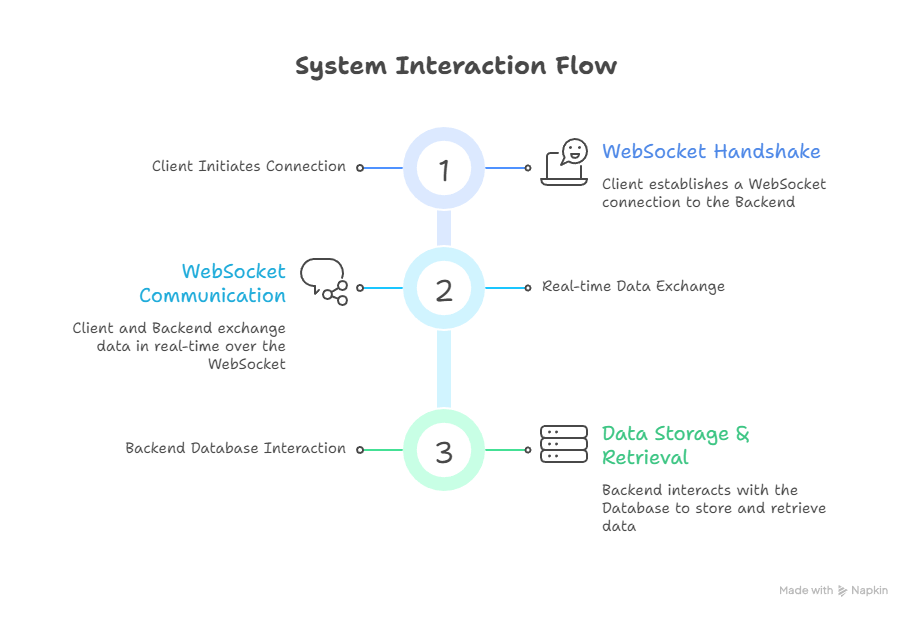
Q8 : What are WebSockets and why use them?
Answer:
- WebSockets enable full-duplex communication between client and server
- Useful for chat apps, live dashboards, notifications
- Implementation in Python: Django Channels, Flask-SocketIO, FastAPI async endpoints
Diagram Idea: Client ↔ WebSocket ↔ Backend ↔ Database
Section 6: Deployment & DevOps Questions
Q9 : How do you deploy a Python Full Stack app?
- Backend: Heroku, AWS Elastic Beanstalk, or Docker containers
- Frontend: Netlify, Vercel, or static hosting
- Configure environment variables, CORS, and SSL certificates
- Set up CI/CD pipelines for automated deployment and testing
Section 7: Behavioral & Scenario Questions
Q10 : How do you handle conflicts in a team project?
Answer:
- Use Git branching strategies and pull requests
- Communicate clearly about changes
- Resolve conflicts via rebasing or merging
- Ensure code review and automated testing before merging to main branch
Tip: Mention CuriosityTech project experiences to showcase teamwork.
Section 8: Sample Practical Coding Questions
Q11 : Create a Django model for a Blog with Comments
from django.db import models
from django.contrib.auth.models import User
class Post(models.Model):
title = models.CharField(max_length=100)
content = models.TextField()
author = models.ForeignKey(User, on_delete=models.CASCADE)
created_at = models.DateTimeField(auto_now_add=True)
class Comment(models.Model):
post = models.ForeignKey(Post, on_delete=models.CASCADE)
content = models.TextField()
author = models.ForeignKey(User, on_delete=models.CASCADE)
created_at = models.DateTimeField(auto_now_add=True)
Q12 : Write a Flask route to fetch all posts
from flask import Flask, jsonify
from models import Post
app = Flask(__name__)
@app.route(‘/api/posts’)
def get_posts():
posts = Post.query.all()
return jsonify([{‘title’: p.title, ‘content’: p.content} for p in posts])
Tip: Always explain your approach, not just code.
Infographic Idea – Interview Preparation Checklist
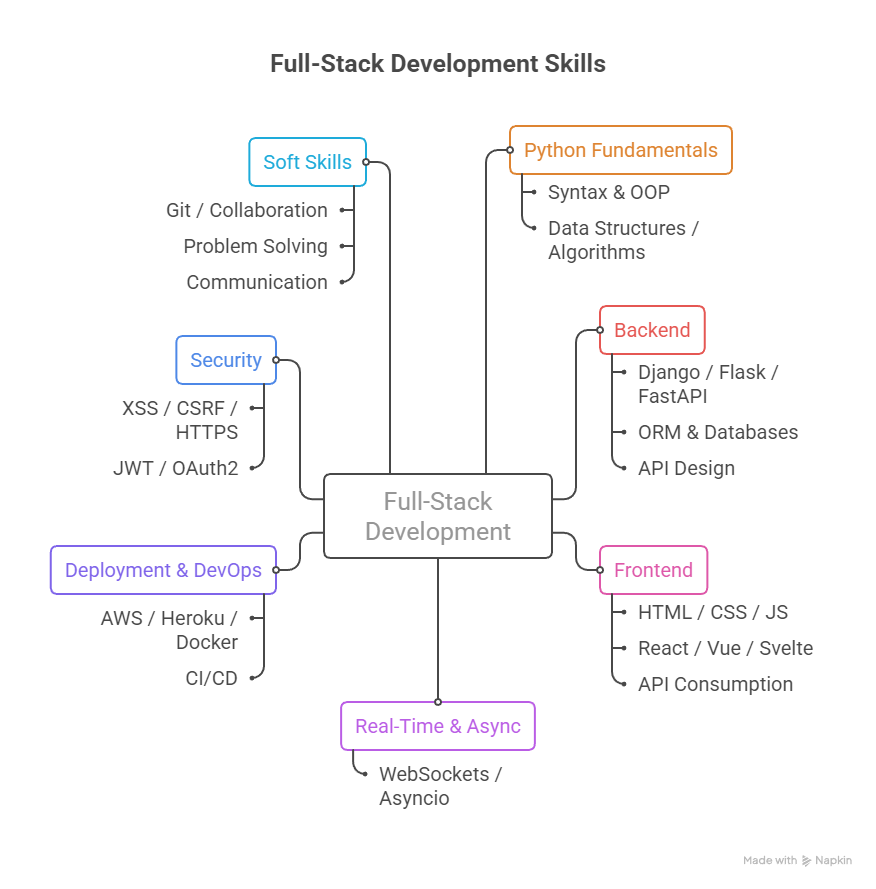
- Covers all technical and behavioral aspects for interviews.
Conclusion
Preparing for a Python Full Stack interview requires both technical mastery and soft skills. Focus on projects, real-world scenarios, system design, and coding exercises, and use a structured checklist to cover all areas.
At Curiosity Tech, students combine hands-on projects, coding exercises, and mock interviews, gaining confidence to excel in Python Full Stack interviews and secure top roles in 2025.