
Introduction
Deep Learning, a subset of Machine Learning, allows computers to learn from large datasets using neural networks. In 2025, deep learning powers applications like image recognition, NLP, autonomous vehicles, and recommendation systems.
At curiosity tech, Nagpur (1st Floor, Plot No 81, Wardha Rd, Gajanan Nagar), we train learners to practically implement deep learning models using TensorFlow and Keras, making the learning journey beginner-friendly yet deeply informative.
This blog provides a comprehensive guide to deep learning concepts, practical workflow, and hands-on examples to help beginners start building neural networks with confidence.
Section 1 – What is Deep Learning?
Definition: Deep Learning uses artificial neural networks (ANNs) with multiple layers to model complex patterns in data.
Analogy: Think of the brain: neurons connected in layers process information. Deep learning mimics this layered neuron structure to make predictions.
Applications:
- Image Classification: Identify objects in photos
- NLP: Chatbots, sentiment analysis, translation
- Speech Recognition: Voice assistants like Alexa or Siri
- Recommendation Systems: Netflix, Amazon
CuriosityTech Story: A learner implemented a deep learning model to classify handwritten digits from the MNIST dataset, gaining practical experience with model layers, activation functions, and loss optimization.
Section 2 – Core Concepts
- Neurons and Layers:
- Input Layer: Receives features
- Hidden Layers: Learn representations
- Output Layer: Provides prediction
- Activation Functions: Introduce non-linearity
- Sigmoid, ReLU, Tanh, Softmax
- Loss Function: Measures prediction error
- Mean Squared Error (MSE) for regression
- Categorical Crossentropy for multi-class classification
- Optimizer: Updates network weights
- SGD, Adam, RMSprop
- Epochs & Batches:
- Epoch: One complete pass through the dataset
- Batch: Subset of data processed at a time
Section 3 – Why TensorFlow & Keras?
TensorFlow:
- Open-source deep learning framework
- Scalable for research and production
- Supports both CPU and GPU training
Keras:
- High-level API for TensorFlow
- Simplifies neural network building with concise code
- Ideal for beginners to implement models quickly
CuriosityTech Tip: We teach learners to transition from Keras for experimentation to TensorFlow for production deployment, ensuring full practical mastery.
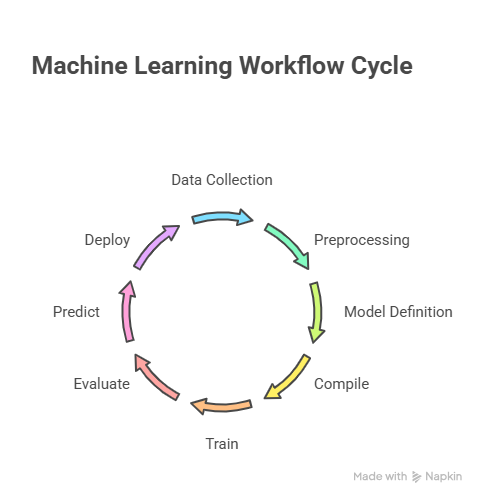
Section 4 – Practical Workflow
- Data Collection & Preprocessing: Normalize or standardize input features
- Define Model Architecture: Specify layers, neurons, and activation functions
- Compile Model: Choose optimizer, loss function, and metrics
- Train Model: Fit the model on training data
- Evaluate Model: Assess accuracy or loss on test data
- Prediction & Deployment: Use model for unseen data
Section 5 – Beginner-Friendly Example: Handwritten Digit Classification
Dataset: MNIST (28×28 grayscale images of digits 0–9)
Python Example (Keras):
import tensorflow as tf
from tensorflow.keras.models import Sequential
from tensorflow.keras.layers import Dense, Flatten
from tensorflow.keras.datasets import mnist
# Load data
(X_train, y_train), (X_test, y_test) = mnist.load_data()
X_train, X_test = X_train/255.0, X_test/255.0 # Normalize
# Build model
model = Sequential([
Flatten(input_shape=(28,28)),
Dense(128, activation=’relu’),
Dense(64, activation=’relu’),
Dense(10, activation=’softmax’)
])
# Compile model
model.compile(optimizer=’adam’, loss=’sparse_categorical_crossentropy’, metrics=[‘accuracy’])
# Train model
model.fit(X_train, y_train, epochs=10, batch_size=32, validation_split=0.1)
# Evaluate
test_loss, test_acc = model.evaluate(X_test, y_test)
print(“Test Accuracy:”, test_acc)
Outcome:
- Learners understand layer architecture, activation, training, and evaluation
- Provides a hands-on introduction to deep learning pipelines
Section 6 – Tips for Beginners
- Start with simple datasets like MNIST or CIFAR-10
- Experiment with different layer sizes, activations, and optimizers
- Visualize training curves for loss and accuracy
- Gradually move to convolutional networks (CNNs) for images and RNNs for sequential data
- At curiosity tech, learners build project portfolios including image classification, text analysis, and time series forecasting
Section 7 – Real-World Project Example
A CuriosityTech learner implemented CNN-based image classification for a fashion dataset:
- Preprocessed 60,000 clothing images
- Built a CNN with Conv2D and MaxPooling layers
- Achieved 92% test accuracy
- Impact: Practical understanding of deep learning deployment for real-world tasks
Section 8 – Best Practices
- Data Augmentation: Improve generalization for image tasks
- Regularization: Use dropout, L2 regularization to prevent overfitting
- Batch Normalization: Accelerates training and stabilizes learning
- Hyperparameter Tuning: Optimize learning rate, batch size, and layer structure
CuriosityTech Tip: Hands-on exposure to hyperparameter tuning and model evaluation equips learners for 2025 AI-driven industry roles
Conclusion
Deep Learning with TensorFlow & Keras empowers data scientists to tackle complex problems in images, text, and sequences. Understanding architecture, training, and evaluation is crucial for building production-ready AI solutions.
At curiosity tech Nagpur, learners gain mentored projects, practical exposure, and portfolio-ready deep learning applications, preparing them for cutting-edge data science careers. Contact +91-9860555369, contact@curiositytech.in, and follow Instagram: CuriosityTechPark or LinkedIn: Curiosity Tech for more resources.

