
Introduction
In today’s enterprise landscape, organizations increasingly adopt hybrid and multi-cloud strategies to avoid vendor lock-in, optimize costs, and achieve scalable, resilient infrastructure.
Google Cloud’s Anthos enables seamless deployment and management of applications across on-premises, GCP, and other cloud providers—providing consistent operations, security, and policy enforcement.
At CuriosityTech.in, engineers are trained to implement hybrid cloud architectures with Anthos, allowing them to orchestrate workloads, automate deployments, and manage clusters across multiple environments.
What is Anthos?
Anthos is Google Cloud’s hybrid and multi-cloud platform, built on Kubernetes, Istio, and GCP services, designed to modernize legacy applications and deploy containerized workloads consistently across environments.
Core Features:
- Multi-cluster management
- Service mesh for secure communication (Istio)
- Policy enforcement and configuration management
- Observability with logging, monitoring, and tracing
- CI/CD integration across hybrid environments
Why Hybrid Cloud?
Hybrid cloud allows organizations to:
- Leverage Existing Investments
Continue using on-premises infrastructure while adopting cloud services. - Enhance Flexibility
Deploy workloads where it makes sense—cloud, on-prem, or edge. - Improve Disaster Recovery
Replicate critical workloads across multiple environments. - Optimize Costs
Dynamically allocate resources based on performance and cost requirements.
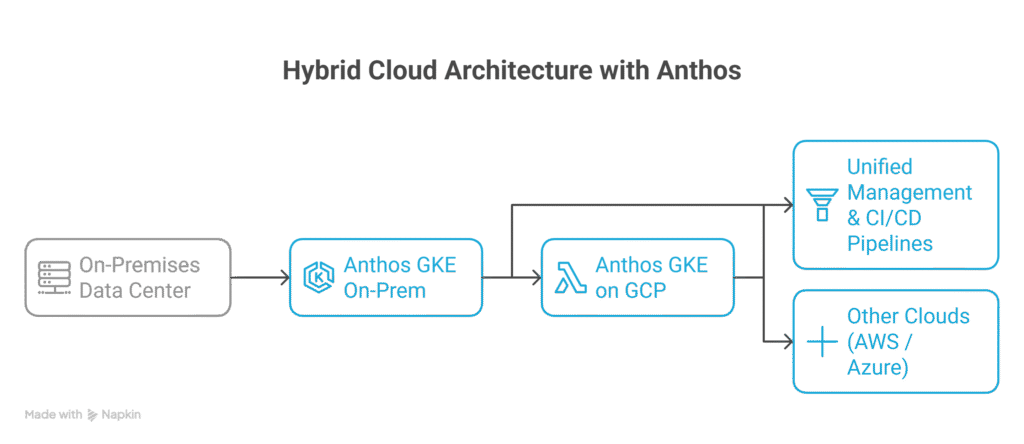
Diagram Concept: Hybrid Cloud Overview with Anthos:
Core Components of Anthos
| Component | Purpose |
|---|---|
| Anthos GKE (AGKE) | Kubernetes clusters on-prem and in GCP for containerized workloads. |
| Anthos Service Mesh | Based on Istio, enables secure service-to-service communication. |
| Anthos Config Management | Centralized policy and configuration management across clusters. |
| Anthos Migrate | Automates migration of VMs to containers running on GKE. |
| Cloud Monitoring & Logging | Unified observability for hybrid deployments. |
Hybrid Cloud Deployment Strategies
1. Lift-and-Shift to Anthos GKE
- Move existing workloads from on-premises VMs to containerized environments
- Leverage Anthos Migrate for automated VM-to-container conversion
2. Hybrid Kubernetes Management
- Maintain on-prem clusters alongside GCP-hosted GKE clusters
- Unified management with Anthos Cluster API and Config Management
3. Multi-Cloud Deployment
- Extend Anthos to AWS or Azure clusters
- Maintain consistent policies, security, and CI/CD pipelines
4. Service Mesh & Security
- Enable secure traffic routing and observability using Anthos Service Mesh
- Apply RBAC, mutual TLS, and network policies across clusters
Step-by-Step: Deploying a Hybrid Cloud Application with Anthos
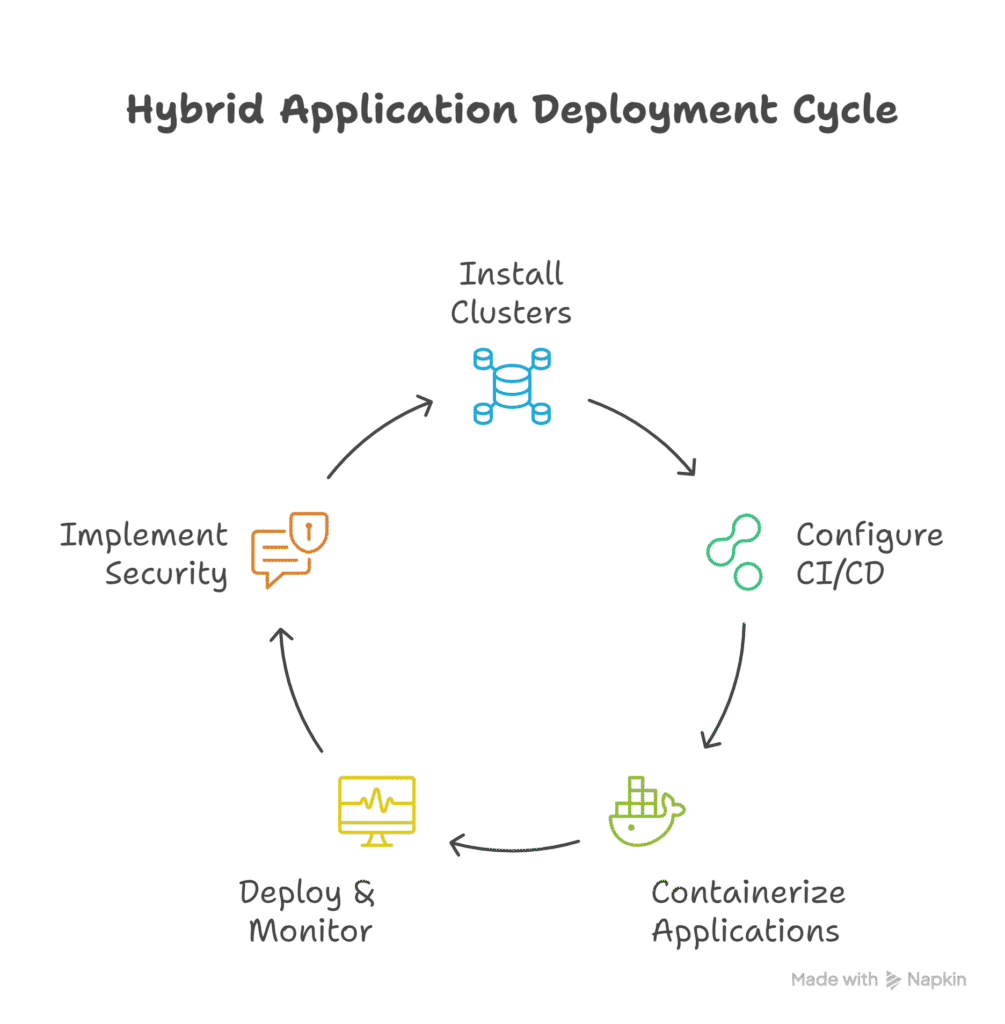
1: Setup Anthos Environment
- Enable Anthos API in GCP project
- Install GKE clusters on-prem and in GCP
- Connect clusters via Anthos Connect
2: Configure CI/CD Pipelines
- Integrate Cloud Build or Jenkins for hybrid deployments
- Use Config Management to enforce deployment policies
3: Containerize Applications
- Package legacy applications into Docker containers
- Use Anthos Migrate for automated conversion of VMs if necessary
4: Deploy & Monitor
- Deploy workloads across clusters using
kubectlor GitOps pipelines - Monitor application health using Cloud Monitoring and Service Mesh dashboards
5: Implement Security & Policies
- Apply Config Management policies for compliance
- Secure communication with Istio mutual TLS
- Audit and log events across hybrid environments
Table: Hybrid Application Deployment Example
| Component | Deployment Environment | Anthos Feature Used |
|---|---|---|
| Web Frontend | GCP GKE | Unified CI/CD, Service Mesh |
| API Layer | On-Prem Anthos GKE | Config Management, Auto Scaling |
| Database | On-Prem / Cloud SQL Hybrid | Observability, Backups |
| Logging & Monitoring | GCP Stackdriver | Centralized Monitoring |
| Security Policies | Across Clusters | Anthos Config Management, Istio |
Best Practices for Hybrid Cloud with Anthos
- Standardize Cluster Configurations :- Ensure uniformity across on-prem and cloud clusters.
- Leverage GitOps :- Manage deployment configurations with version-controlled repositories.
- Implement Zero-Trust Security :- Use Anthos Service Mesh for secure service-to-service communication.
- Monitor & Audit Continuously :- Maintain visibility of workloads, policies, and network traffic.
- Automate Migration & Scaling :- Use Anthos Migrate and cluster autoscaling for efficiency.
- Disaster Recovery Planning :- Deploy workloads across multiple clusters to ensure redundancy.
Practical Example: Hybrid Retail Application
Scenario: Retail organization with legacy on-prem POS system and cloud-based analytics.
- POS Backend: On-premises GKE cluster with Anthos Migrate for legacy VMs
- Analytics Microservices: GCP GKE cluster for real-time data processing
- Service Mesh: Secure communication between POS and analytics services
- Unified CI/CD: Cloud Build pipeline deploys changes to both clusters
- Monitoring: Centralized dashboards track transaction latency, errors, and cluster health
Advanced Strategies
- Multi-Cloud Disaster Recovery :- Deploy critical services across GCP and AWS for redundancy.
- Dynamic Workload Placement :- Move workloads between clusters based on performance or cost.
- Policy-Driven Automation :- Use Config Management to enforce compliance and security automatically.
- Edge Deployment :- Extend Anthos to edge locations for latency-sensitive applications.
Conclusion
Hybrid cloud adoption with Anthos enables organizations to modernize applications, achieve operational consistency, and scale efficiently.
By mastering Anthos, engineers can deploy multi-cloud and hybrid applications securely and reliably, leverage CI/CD pipelines, and enforce policies across diverse environments.
At CuriosityTech.in, engineers gain hands-on experience in hybrid cloud architecture, Anthos deployment, service mesh, and CI/CD integration—preparing them for enterprise-grade multi-cloud operations.