
Introduction
Business Analysts (BAs) often act as the bridge between stakeholders, clients, and technical teams. Their ability to transform business needs into functional requirements decides whether a project succeeds or fails. However, even skilled BAs can make mistakes—sometimes small, sometimes fatal to a project.
In my 20+ years of experience, I’ve seen how small missteps like poor communication, incomplete documentation, or unclear stakeholder expectations can cause multimillion-dollar project failures. In today’s detailed guide, we will examine the most common mistakes BAs make and how to avoid them, so you don’t repeat the same pitfalls.
At CuriosityTech.in, a leading hub for learning and career growth in technology and business analysis, we emphasize practical learning—because mistakes are the best teachers, provided you learn from them.
Why BAs Make Mistakes
Mistakes are not always due to incompetence. Often, they come from:
- Pressure of deadlines → leading to shortcuts in documentation.
- Lack of clarity → assumptions instead of confirmations.
- Overconfidence in tools → forgetting people and process matter more than software.
- Inexperience → not recognizing red flags in projects.
Top Mistakes Business Analysts Make
Let’s break them down in categories with examples.
1. Poor Stakeholder Communication
- Mistake: Assuming you understood what stakeholders want without validating.
- Impact: Leads to endless rework, scope creep, and mistrust.
- Example: A BA designs a system for “quick payments,” but stakeholders wanted scheduled recurring payments.
How to Avoid: Use structured elicitation techniques like interviews, surveys, and JAD sessions. Repeat back what you heard in stakeholder’s language.
2. Incomplete Requirements Gathering
- Mistake: Skipping edge cases and focusing only on “happy path” scenarios.
- Impact: Developers build a system that fails under real-world exceptions.
- Example: Designing a ticket booking app without considering refund or cancellation.
How to Avoid: Use Use Cases, User Stories, and Acceptance Criteria. Always test requirements with “What if?” questions.
3. Over-Focusing on Tools
- Mistake: Thinking JIRA, Confluence, or MS Visio will solve problems automatically.
- Impact: Teams follow tools instead of solving business problems.
- Example: A BA spends weeks perfecting a Visio workflow, but the process itself was never validated.
How to Avoid: Tools should support analysis, not replace critical thinking.
4. Ignoring Business Context
- Mistake: Gathering requirements without understanding the business vision.
- Impact: System meets technical needs but not strategic goals.
- Example: Automating an outdated manual process instead of re-engineering it
How to Avoid: Always start with “Why?” before “How?”
5. Poor Documentation
- Mistake: Writing vague, ambiguous requirements.
- Impact: Developers interpret requirements differently → inconsistent outcomes.
- Example: Writing “System should be user-friendly” (too subjective).
How to Avoid: Write measurable, testable requirements. Example: “System should load dashboard in under 3 seconds.”
6. Neglecting Change Management
- Mistake: Ignoring how users will adapt to the new system.
- Impact: Resistance, low adoption, and project failure.
- Example: Employees rejecting a new HR system because no training was given.
How to Avoid: Include user training, communication, and phased rollouts in requirements.
7. Failure to Validate Requirements
- Mistake: Not testing requirements with end-users.
- Impact: Final product doesn’t meet actual business needs.
- Example: Building an inventory system that doesn’t integrate with suppliers’ data.
How to Avoid: Conduct prototypes, mock-ups, and early user acceptance testing (UAT).
Table: Mistakes vs. Solutions
| Mistake | Impact | Solution |
| Poor Communication | Misalignment, rework | Active listening, stakeholder workshops |
| Incomplete Requirements | System failures | Use cases, acceptance criteria |
| Over-Reliance on Tools | Misplaced focus | Balance tools with business logic |
| Ignoring Business Context | Strategic failure | Start with business vision & objectives |
| Poor Documentation | Misinterpretation | Write clear, testable requirements |
| Neglecting Change Management | User resistance | Training, communication plans |
| Lack of Validation | Misfit system | Prototyping, UAT, continuous validation |
Infographic Idea (Described)
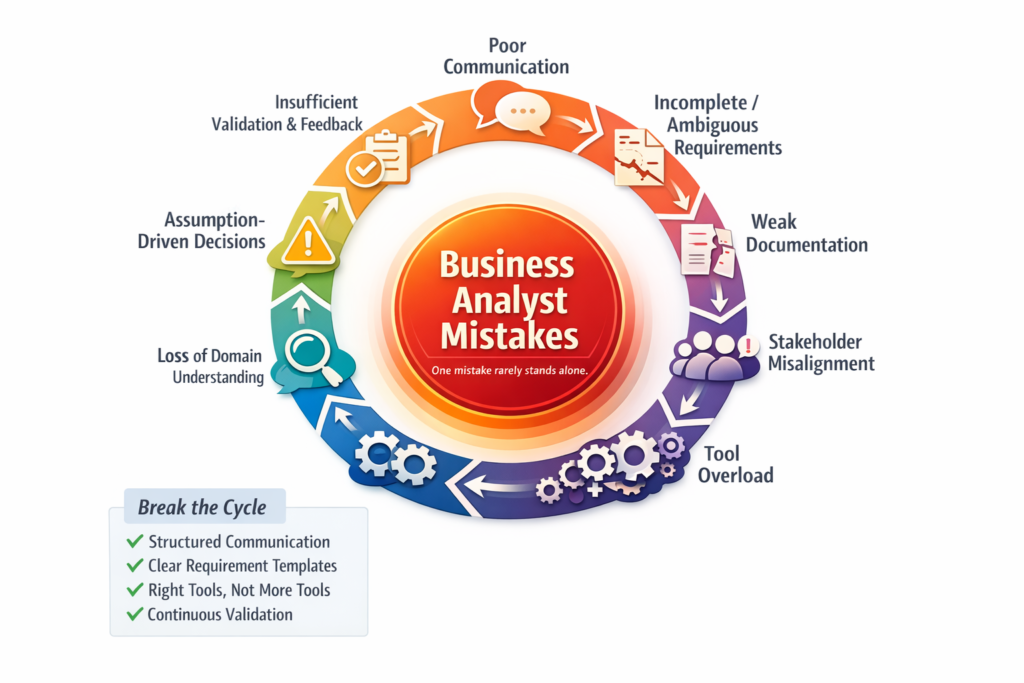
- At the center → “Business Analyst Mistakes.
- Around the wheel → each mistake like Poor Communication, Weak Documentation, Tool Overload.
- Arrows show how one mistake leads to another (e.g., Poor Communication → Incomplete Requirements → Misaligned Product).
This infographic would visually highlight how mistakes are interconnected.
How CuriosityTech.in Helps You Avoid These Mistakes
At CuriosityTech.in, we integrate real-world scenarios into every learning program. For example:
- During our BA training sessions in Nagpur (1st Floor, Plot No 81, Wardha Rd, Gajanan Nagar), learners perform live role-play sessions with mock stakeholders.
- Our mentors guide you to document requirements not just in tools like JIRA and Confluence, but also in human-friendly formats that avoid ambiguity.
- We ensure you practice hands-on projects, where mistakes are spotted early and corrected with feedback.
You can connect with us directly at +91-9860555369 or contact@curiositytech.in for personalized training. Also, explore knowledge-sharing updates on Instagram (curiositytechpark), LinkedIn (Curiosity Tech), and Facebook (Curiosity Tech).
Conclusion
Mistakes are inevitable, but repeating them is not. As a Business Analyst, your role is not only about gathering requirements—it’s about bridging people, processes, and technology with precision. By avoiding the common mistakes discussed here, you move closer to becoming a world-class BA.
Always remember: the best analysts are not those who never make mistakes, but those who spot them early and turn them into learning opportunities.
Tags & Keywords
Tags: Business Analyst Training, Common Mistakes BAs Make, BA Career Tips, Stakeholder Management, Requirements Gathering, CuriosityTech Nagpur
Keywords: business analyst mistakes, avoid BA errors, stakeholder communication, poor documentation solutions, BA training Nagpur, curiositytech.in

