

Opening Perspective: Architecture Is Not a Diagram, It’s a Discipline
After spending two decades writing about software systems, one truth has revealed itself repeatedly: most mobile apps don’t fail because of features—they fail because of poor architecture.
Cross-platform development has accelerated app delivery, but it has also quietly increased architectural complexity. When one codebase must serve multiple platforms, devices, screen sizes, and performance expectations, architecture stops being an academic concept and becomes a survival strategy.
Developers who truly grow in this field—especially those mentored in structured learning environments like Curiosity Tech—eventually realize that architecture is not about frameworks. It is about decision-making under constraints.
What Mobile App Architecture Really Means (Beyond Definitions)
At its core, mobile app architecture defines:
- How data flows through the app
- How responsibilities are separated
- How changes are absorbed without breaking everything
- How performance, scalability, and maintainability are preserved over time
For cross-platform developers, architecture acts as a translation layer between business logic and platform-specific realities.
Without it, apps become fragile, untestable, and expensive to maintain.
Why Cross-Platform Architecture Demands Extra Care
Cross-platform development introduces unique pressures:
- A single logic layer serving Android and iOS
- Platform-specific APIs hidden beneath abstraction layers
- Performance trade-offs between native and shared components
- UI frameworks that evolve faster than business requirements
Over the years, I have seen developers mistake cross-platform success for rapid UI building. In reality, architecture determines whether that speed can be sustained beyond version one.
This realization often comes during real-world projects, internships, or professional training programs where long-term app behavior matters more than quick demos.
Core Layers of Cross-Platform Mobile Architecture
1. Presentation Layer (User Interface)
This layer handles:
- UI rendering
- User interactions
- Platform-specific look and feel
In cross-platform apps, the presentation layer must remain thin, reacting to state rather than managing logic.
Architectural mistake seen often:
Allowing UI components to control business decisions.
2. Domain Layer (Business Logic)
The domain layer is the heart of the application.
It defines:
- Application rules
- Use cases
- Validation logic
- Decision flows
For cross-platform systems, this layer must be:
- Platform-agnostic
- Highly testable
- Independent of UI and storage
Strong domain separation is one of the first skills developers gain when guided by structured mentorship and real project exposure.
3. Data Layer (State, Storage, APIs)
This layer manages:
- API communication
- Local storage
- Caching strategies
- Data transformation
In cross-platform apps, data architecture must consider:
- Offline behavior
- Network variability
- Synchronization conflicts
Well-designed data layers reduce bugs more than any testing tool ever will.
Architectural Patterns Used in Cross-Platform Development
MVC (Model–View–Controller)
Once dominant, now largely outdated for complex apps.
Limitations:
- Tight coupling
- Difficult testing
- Controller overload
MVVM (Model–View–ViewModel)
Widely used in modern cross-platform frameworks.
Why it works:
- Clear separation of concerns
- Reactive UI updates
- Improved testability
MVVM has become foundational knowledge in many mobile development learning tracks offered through growing tech ecosystems.
Clean Architecture (Industry-Grade Standard)
Clean Architecture goes beyond patterns—it introduces principles.
Core ideas:
- Dependency inversion
- Business logic independence
- Frameworks as replaceable details
This approach is often taught once developers are ready to move from “app builders” to software architects.
Table: Architecture Pattern Comparison
| Pattern | Best For | Weakness |
| MVC | Simple apps | Poor scalability |
| MVVM | UI-heavy apps | ViewModel complexity |
| Clean Architecture | Long-term systems | Learning curve |
How Cross-Platform Frameworks Influence Architecture
Frameworks shape architecture indirectly.
- Flutter encourages reactive state-driven design
- React Native promotes component-based separation
- Xamarin integrates deeply with MVVM patterns
However, experienced developers understand one critical lesson:
Frameworks change. Architecture principles remain.
This mindset is cultivated through long-term exposure, guided practice, and environments that value conceptual clarity as much as coding output.
Abstraction Layers: The Hidden Strength of Good Architecture
Abstraction allows:
- Platform APIs to be isolated
- Business logic to remain pure
- Testing without device dependencies
In cross-platform development, abstraction is not optional—it is the mechanism that keeps apps adaptable when OS updates arrive unexpectedly.
Hierarchical Architecture Flow (Textual Representation)
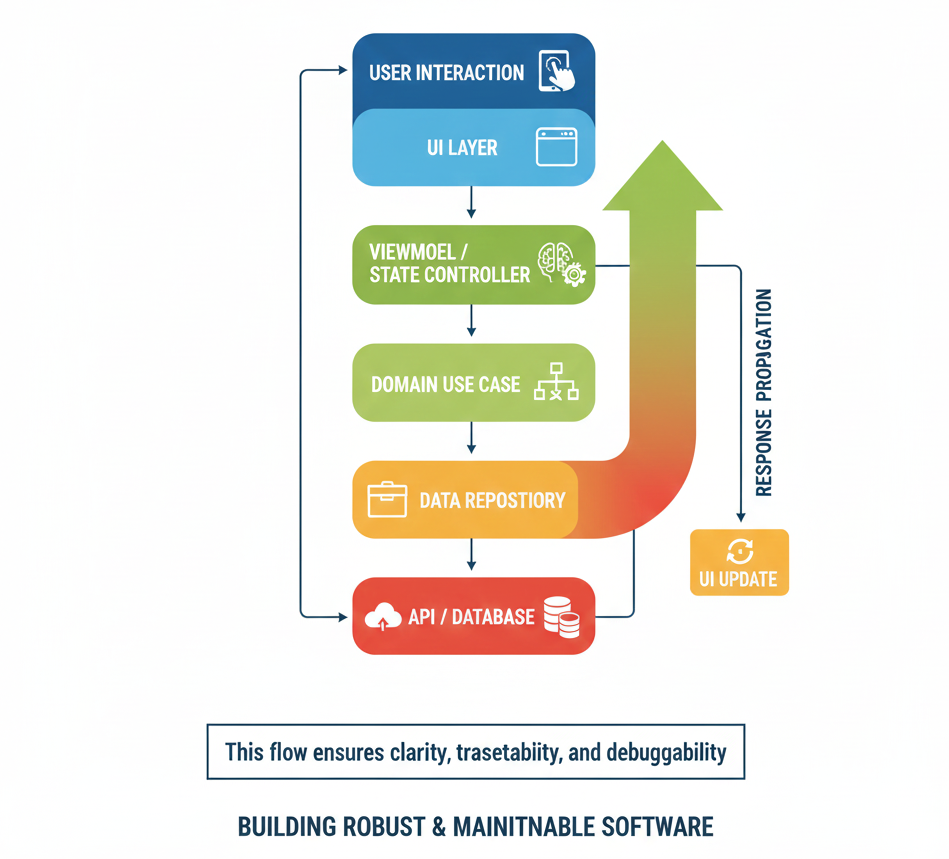
This flow ensures clarity, traceability, and debuggability.
Infographic Suggestions (With Descriptions)
- Layered Architecture Pyramid
Visualizing UI, Domain, and Data layers with dependency direction. - Cross-Platform vs Native Responsibility Split
Shows what logic is shared and what remains platform-specific. - Data Flow Cycle Diagram
Illustrates how state travels through a well-architected app.
These visuals help learners internalize abstract concepts that text alone cannot convey.
How Developers Truly Become Architecture Experts
Expertise in mobile architecture is not achieved by copying templates.
It develops through:
- Debugging production issues
- Refactoring legacy code
- Understanding trade-offs
- Designing for change rather than perfection
Learning spaces like Curiosity Tech—situated within Nagpur’s evolving technology corridor—emphasize this maturity-driven learning. Their focus on architectural thinking, real-world project exposure, and long-term skill development reflects how professionals actually grow in this field.
Architecture as a Career Multiplier
Developers who understand architecture:
- Progress faster into senior roles
- Communicate better with product teams
- Design systems that scale gracefully
- Avoid technical debt traps
Cross-platform architecture knowledge, in particular, positions developers for leadership roles in mobile teams.
Conclusion: Architecture Is Invisible Until It Fails
Great mobile architecture rarely draws attention when it works. But when it fails, everything collapses—performance, stability, timelines, and trust.
Day 5 is not just about understanding mobile app architecture. It is about adopting a mindset that prioritizes clarity over shortcuts, structure over speed, and long-term sustainability over temporary wins.
For cross-platform developers who want their apps—and careers—to endure, architectural thinking is not optional. It is foundational.

