

Introduction
When someone starts learning PHP, they often rush straight into frameworks, databases, and APIs. But the truth every experienced PHP developer knows is this: your strength in PHP depends on how well you understand its core.
After working with PHP for over 20 years across corporate portals, startup products, and high-traffic eCommerce platforms, I can say with confidence that developers who master variables, loops, and functions are the ones who write faster, cleaner, and more secure applications.
At CuriosityTech, located in Nagpur on Wardha Road, this exact philosophy is followed when training future developers. Whether a student walks in with zero coding experience or with some IT background, they are taken through the core building blocks of PHP before moving to frameworks like Laravel. That is how real developers are built.
Today on Day 6, we go deep into the heart of PHP.
1. Understanding Variables in PHP
A variable in PHP is more than just a container. It represents memory allocation, data typing, and runtime decision-making.
How PHP Handles Variables Internally
Unlike strongly typed languages (Java, C#), PHP is dynamically typed. This means:
| Feature | PHP Behavior |
| Data type | Determined at runtime |
| Memory | Automatically managed |
| Conversion | Happens automatically |
| Scope | Local, global, static |
When you write:
$price = 1500;
PHP automatically allocates memory, decides it is an integer, and tracks it until execution ends.
Later:
$price = “1500”;
Now PHP converts the same variable into a string. This flexibility makes PHP powerful but also dangerous if not understood properly.
At CuriosityTech, students are trained to treat variables carefully to avoid bugs, injection attacks, and data loss.
Types of Variables in Real Projects
PHP developers don’t just use variables for numbers and text. In real web applications, variables represent:
| Variable Type | Real-World Example |
| String | User name, email |
| Integer | User ID, product quantity |
| Float | Product price |
| Boolean | Login status |
| Array | Cart items |
| Object | User profile |
| Null | Empty database field |
This is exactly how online stores, login systems, and admin panels are built.
2. Loops – The Engine That Powers Web Apps
Without loops, no web application would exist. Everything from product listings to notifications to reports depends on loops.
Why Loops Are So Powerful
Imagine an online store built using PHP.
One user has 2 products in the cart.
Another user has 200.
You cannot manually write code for each product.
Loops let PHP process unlimited data with limited code.
Types of Loops in PHP
| Loop Type | When Used |
| for | Known number of repetitions |
| while | Unknown repetitions |
| do-while | Must run at least once |
| foreach | Working with arrays & objects |
Real-World Example
When CuriosityTech students build dynamic websites, they use foreach to display:
- Products from database
- Blog posts
- Users in admin panels
- Messages in inbox
Loops are the reason one PHP file can display thousands of database records.
3. Functions – How Professionals Write PHP
Functions are what separate beginners from professionals.
A function is a reusable block of logic. Instead of repeating the same code everywhere, you write it once and call it anywhere.
Why Functions Matter in Web Applications
Every time you:
- Validate a form
- Send an email
- Check login
- Format currency
- Connect to database
You should be using functions.
At CuriosityTech, students are trained to build modular systems using functions from the beginning, so when they later move to Laravel, they already think like software engineers.
Hierarchical Flow of PHP Core Concepts
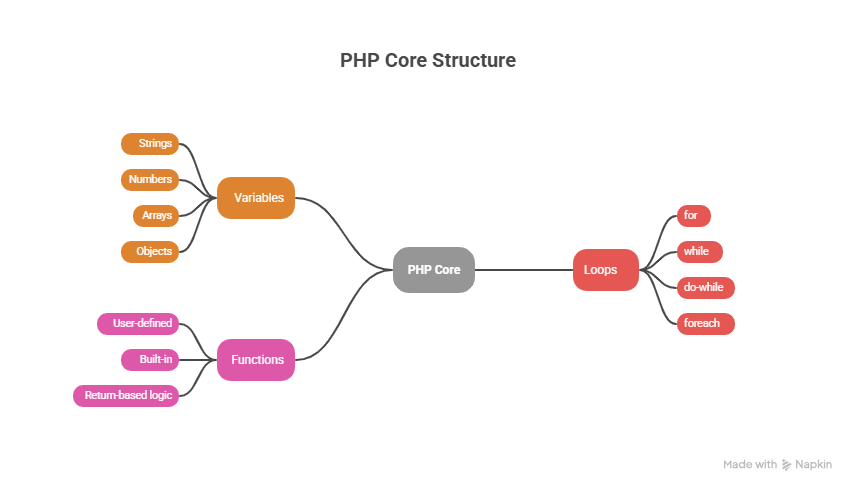
This structure is the same one used in production-level PHP systems.
Infographic Description
Title: How PHP Core Powers a Website
Visual Flow:
User Request → Variables → Loop → Function → Output Page
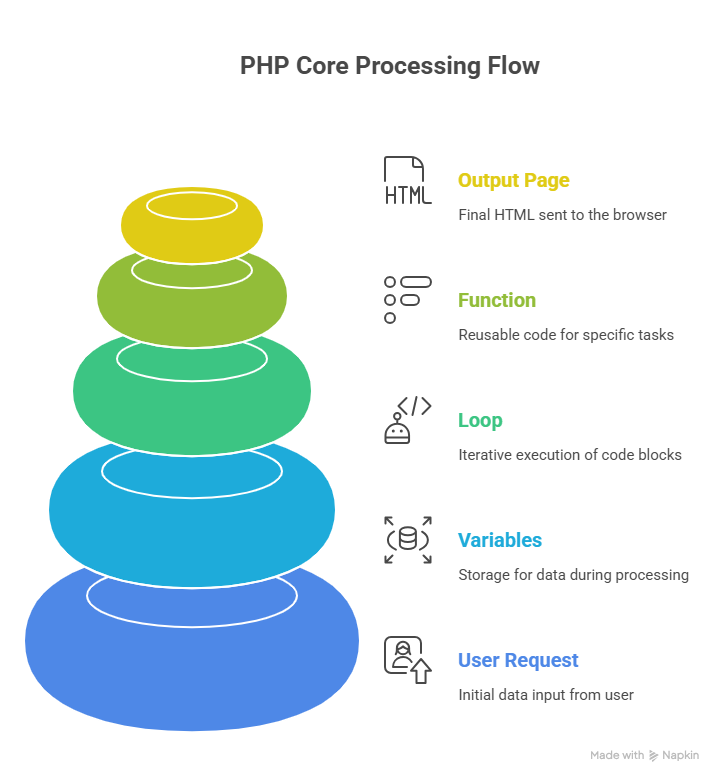
This shows how PHP receives data, processes it, and returns HTML to the browser.
Why CuriosityTech Teaches Core PHP First
Many institutes jump directly to Laravel. But CuriosityTech, based in Nagpur with direct mentorship from industry experts, ensures students master:
- Variable handling
- Loop logic
- Functional programming
This foundation is why their students can later handle APIs, payments, authentication, and complex databases confidently.
Anyone can learn syntax. Only trained developers understand logic.
Conclusion
Core PHP is not outdated. It is the foundation of every PHP framework.
Laravel, WordPress, Magento, and custom enterprise systems all run on the same PHP core.
By mastering variables, loops, and functions, you are not just learning PHP — you are learning how web applications think.
That is why institutes like CuriosityTech don’t treat PHP basics as beginner material; they treat it as professional training.

