
Introduction
The Java Collections Framework (JCF) is a cornerstone for any Java Full Stack Developer. Collections provide pre-built data structures that simplify the storage, retrieval, and manipulation of data in Java applications. From lists and sets to maps and queues, understanding collections is vital for efficient backend logic and high-performance applications.
At CuriosityTech.in, developers learn hands-on usage of collections in real-world full stack projects, ensuring their Java applications are scalable, maintainable, and efficient.
Why Java Collections Are Important
- Efficient Data Management: Store and access large amounts of data efficiently.
- Reusability: Pre-built implementations like ArrayList, HashMap, and HashSet save development time.
- Performance Optimization: Choose the right data structure to optimize memory and speed.
- Real-World Applicability: Used extensively in full stack projects for tasks like caching, database interaction, and API responses.
CuriosityTech.in emphasizes practical application of collections, ensuring students can choose the right data structure for the right problem.
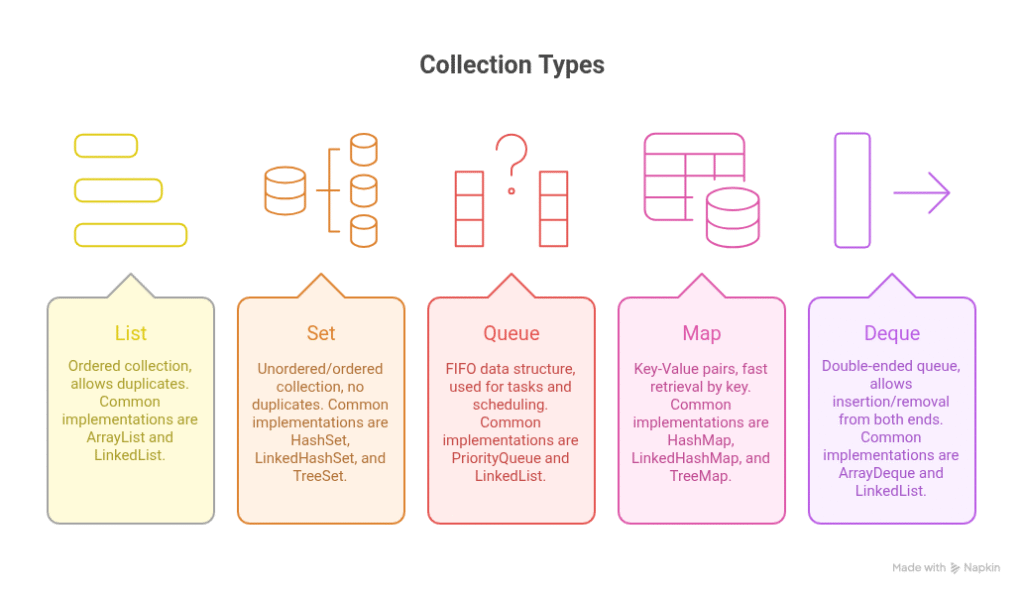
Core Components of the Java Collections Framework
| Collection Type | Common Implementations | Description |
| List | ArrayList, LinkedList | Ordered collection, allows duplicates |
| Set | HashSet, Linked HashSet, Tree Set | Unordered/ordered collection, no duplicates |
| Queue | PriorityQueue, LinkedList | FIFO data structure, used for tasks and scheduling |
| Map | HashMap, Linked HashMap, Tree Map | Key-Value pairs, fast retrieval by key |
| Deque | ArrayDeque, LinkedList | Double-ended queue, allows insertion/removal from both ends |
Example 1: Using ArrayList for Dynamic Data Storage
import java.util.ArrayList;
import java.util.List;
public class ProductListExample {
public static void main(String[] args) {
List<String> products = new ArrayList<>();
products.add(“Laptop”);
products.add(“Smartphone”);
products.add(“Headphones”);
// Iterate and display
for(String product : products){
System.out.println(product);
} } }
Example 2: Using HashMap for Key-Value Storage
import java.util.HashMap;
import java.util.Map;
public class ProductPriceMap {
public static void main(String[] args) {
Map<String, Double> productPrices = new HashMap<>();
productPrices.put(“Laptop”, 850.00);
productPrices.put(“Smartphone”, 500.00);
productPrices.put(“Headphones”, 75.00);
productPrices.forEach((k,v) -> System.out.println(k + ” -> $” + v));
} }
Example 3: Using Queue for Task Management
import java.util.LinkedList;
import java.util.Queue;
public class TaskQueue {
public static void main(String[] args) {
Queue<String> tasks = new LinkedList<>();
tasks.add(“Process Order #101”);
tasks.add(“Update Inventory”);
tasks.add(“Send Invoice”);
while(!tasks.isEmpty()){
System.out.println(“Processing: ” + tasks.poll());
} } }
Diagram: Collections Usage in Full Stack Workflow
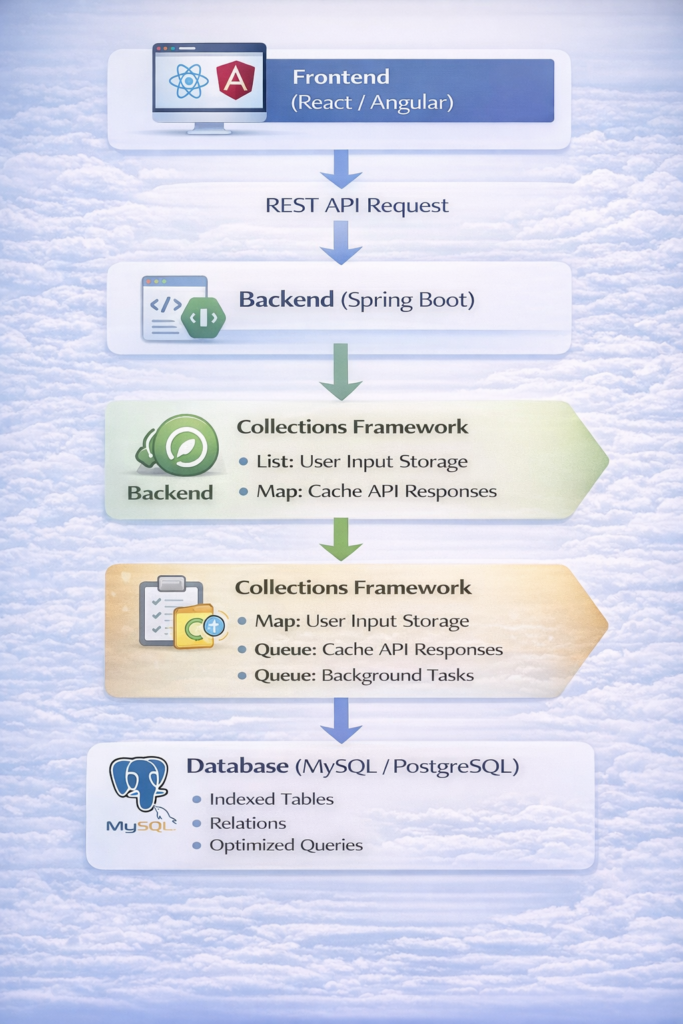
Description :- Collections are used in the backend to handle dynamic user data, caching, and task scheduling, ensuring the application remains efficient and responsive.
Best Practices
- Choose the right collection type for your use case (e.g., use HashSet to avoid duplicates).
- Prefer interfaces (List, Set, Map) in method signatures for flexibility.
- Use Generics to avoid type casting errors.
- Synchronize collections in multi-threaded environments.
- Leverage Stream API for modern, efficient data processing.
Integrating CuriosityTech Perspective
At CuriosityTech.in, students use collections extensively in project-based learning. Examples include shopping cart management in e-commerce apps, caching API responses, and scheduling background jobs. This ensures that developers can efficiently manage data in full stack projects, which is crucial for performance and maintainability.
Conclusion
The Java Collections Framework is essential for every Full Stack Developer. Mastering lists, sets, maps, queues, and deques allows you to efficiently store, retrieve, and process data, which directly impacts the performance of your applications. With hands-on guidance from CuriosityTech.in, developers gain the practical expertise to implement collections in real-world projects confidently.

